Is It Rude To Not Tip In Rome?
No, tipping is not rude to skip in Rome, but the bill carries charges travellers mistake for tips. The coperto is actually banned in Lazio, servizio must be shown before you order, and the one place a tip is genuinely expected is a guided food tour.
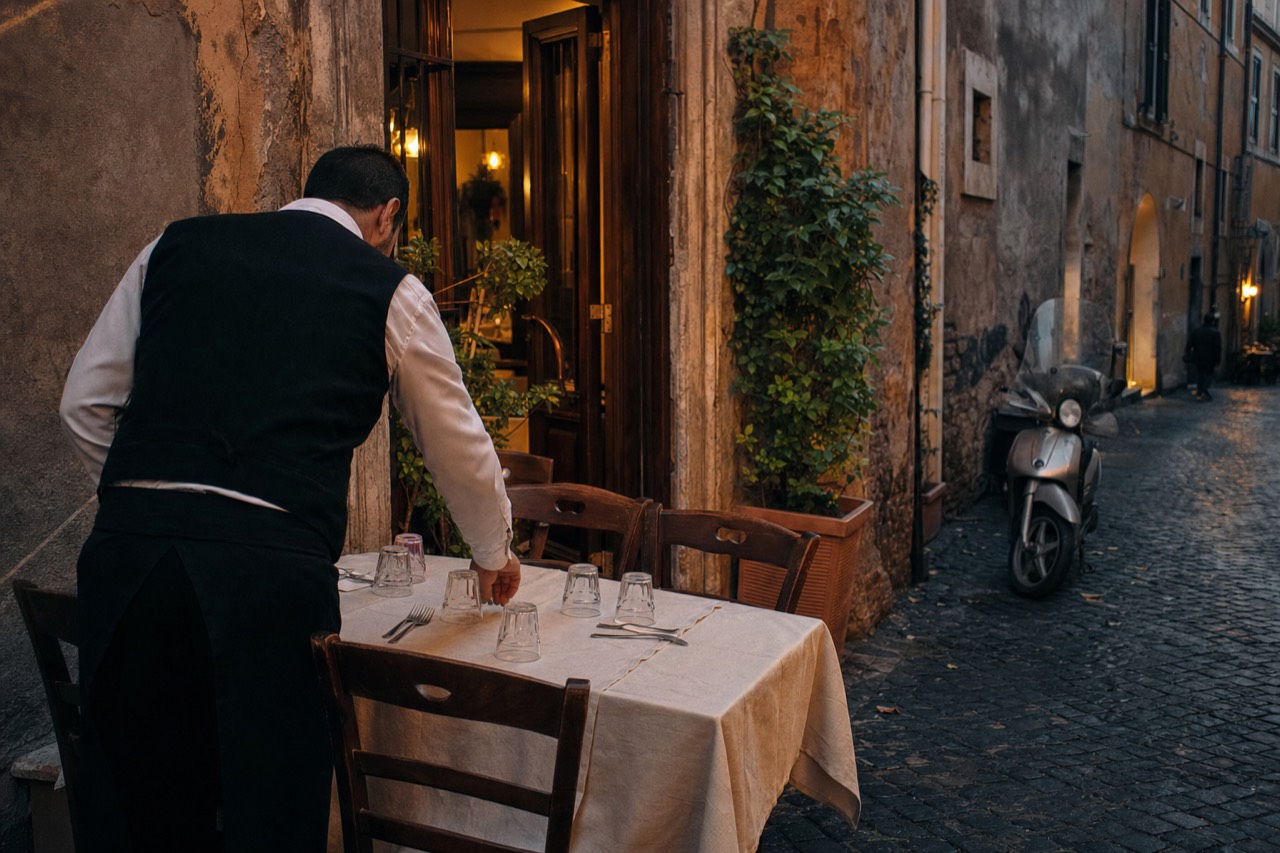
No, it is not rude to leave no tip in Rome. Tipping in Italy is optional, not expected, and never a percentage obligation: Italians commonly leave nothing, round the bill up, or leave small change when service was genuinely good. The confusion on a Roman bill comes from two other charges, the coperto and the servizio, which are separate things, and one of them is banned outright. The polite Roman move is not a calculated tip. It is rounding, or a few coins, and nobody at the table thinks twice about it either way.
Travellers arrive carrying the American question, the British question and a pocketful of blog advice, and the bill that lands in front of them in Rome seems to answer none of it. A line labelled pane, or servizio, or coperto sits on the total, and the instinct is to treat it as a tip already charged, then add one on top, then wonder whether the whole thing was rude.
It was not. The three items do completely different jobs. One is a prohibited charge that some Roman restaurants levy anyway. One is a lawful service charge that has to be shown to you before you order. And one is an optional, unscripted gesture that the staff do not budget for and do not expect. Once you can tell them apart, the anxiety goes away, because the only one you control is the one nobody requires.
The practical core of the answer sits in one table. Read the bill against it, and the rest of this article explains each row in turn.
| Charge on the bill | What it is | Lawful in Rome? | What you do |
|---|---|---|---|
| Coperto | A per-person cover charge for the table and bread | Prohibited in Lazio under regional law 21/2006 | Point at the law calmly, or pay and note it; never add a tip on top |
| Servizio | A service percentage, part of the price | Lawful only if shown on the price list before you order | It is already the service charge; no extra tip is needed |
| Mancia, the tip | An optional gesture from you | Always lawful, never expected | Leave nothing, round up, or leave small change, your call |
The one context where a tip is genuinely expected in Rome is a guided food tour, and that is the subject of a later section, because it is the single exception to everything above. For now, the short version: a guide who has walked you through Trastevere for three hours is tipped like anyone else who personally steered your evening, and the operator's listing makes that easy with a fixed price booked in advance.
For a first evening in the city that removes every question at once, the street food walks below cover several counters in one outing at a price fixed before you go, with the reservation problem solved before you land. This is the shape of advice Best Restaurants in Rome exists to give: the mechanic behind the charge, not a percentage to copy.
What Is The Coperto Charge In Rome?
The coperto is a per-person charge for the table itself, often relabelled as pane, bread, and in Lazio it is prohibited. Regional law 21/2006, article 16, states plainly that it is forbidden to apply additional costs for the coperto. Some Rome restaurants charge one anyway, which is documented, but a visitor cannot be obliged to treat it as normal, and it is absolutely not a tip. It is the charge travellers most often mistake for an automatic gratuity, which is exactly backwards: it is the one line on the bill that is not supposed to be there at all.
The word causes trouble because the generic-Italy advice, and every guidebook paragraph about Florence, describes the coperto as a customary, harmless table charge, though regional law bans it in Rome. That is true in some regions and false in Lazio. Rome's rule is the inverse, and the law is short enough to quote in spirit: where service is at the table, the price list must be available before you order, any service component must be shown so the price is clear, and a coperto charge is prohibited.
Why do you still see it? Because enforcement is thin and many diners, Italian and foreign, do not know the rule exists. Italian food media has covered the gap more than once, and the honest position for a traveller is calm: know the charge is not lawful in Rome, decide whether a quiet word or a quiet payment suits your evening better, and never stack a tip on top of it in the belief that it was a service charge. It was not.
There is no printable figure for what Roman places charge, and any page handing you a neat range for a coperto is passing on somebody's blog arithmetic. What is printable is the mechanic: the charge appears as a per-person line, sometimes labelled pane, and the lawful alternative is the servizio, which must be disclosed before you order. If you want the source itself, the Lazio regional council publishes the law.
The practical takeaway for the tipping question is simple. If a coperto line appears, you have already been charged for the table by a mechanism that should not exist in Rome. Adding a percentage tip because you believe the restaurant underpaid its staff through that line is double-paying for a charge that was not lawful in the first place.
What Is The Servizio Charge In Rome?
The servizio is a service charge expressed as a percentage of the bill, and in Lazio it is lawful under exactly one condition: the price list, showing it, must be given to you before you order. That disclosure duty is the diner's real protection. Where servizio is properly disclosed, it is the service charge, and no additional tip is expected on top of it, though nobody will refuse one. This is the charge that most closely resembles an automatic gratuity, and it is the one that genuinely answers part of the tipping question.
The distinction between servizio and coperto matters because travellers treat them as the same thing. They are not. The coperto is a flat per-person charge and it is banned. The servizio is a percentage and it is legal, but only with the before-ordering disclosure, which is the part of the law that protects you. A service charge that appears on the bill for the first time after the meal, having never been shown on the menu, is in breach of the disclosure rule, and that is a fair, calm thing to point out.
A bar cousin of the same rule explains coffee prices, and it is the most useful money mechanic in the city. Two prices are posted for the same drink, one for standing at the counter and one for sitting at a table, and you choose which you are buying before you sit. The bar is not cheating you with the table price, it is selling you a different thing, a seat, and Italian law requires both prices to be posted clearly. Drink your espresso standing at the bar the way Romans do, and the whole question of the difference never arises.
A food tour sidesteps all of this for an evening, which is worth stating plainly. The price is fixed before you go, booked like any other ticket, and nothing on the final tally comes as a surprise at the table. Whether one is worth it is its own question, and the are food tours in Rome worth it breakdown covers the arithmetic; for the tipping-anxious, the appeal is that no bill arrives at all.
Is The Coperto Legal In Rome Restaurants?
No, a separate coperto charge is not legal in Rome. Lazio regional law 21/2006, article 16 comma 3, prohibits applying additional costs for the coperto where there is table service, and Rome sits inside Lazio. The service percentage, the servizio, is the lawful alternative, and only where the price list showing it is made available before you order. That is the whole legal picture, and it is the inverse of Florence, where the coperto is charged normally.
This is the fact that separates honest Rome advice from recycled generic-Italy advice. A page that tells you to budget a per-person coperto charge in Rome is describing another city, or repeating a blog number that nobody sourced. The law exists, it is current, it is short, and the restaurateurs of Rome know it as well as anyone, which is why the charge, when it appears, tends to wear a borrowed name. Pane is the favourite.
What a diner does with the knowledge is a personal call. Two positions are both defensible. One: query the line at the desk, politely, citing the regional rule, and most rooms will remove it rather than argue law with a customer holding a phone. Two: pay it and treat it as the cost of not having the conversation on holiday. What is not defensible is being talked into believing it was an automatic tip you were expected to top up.
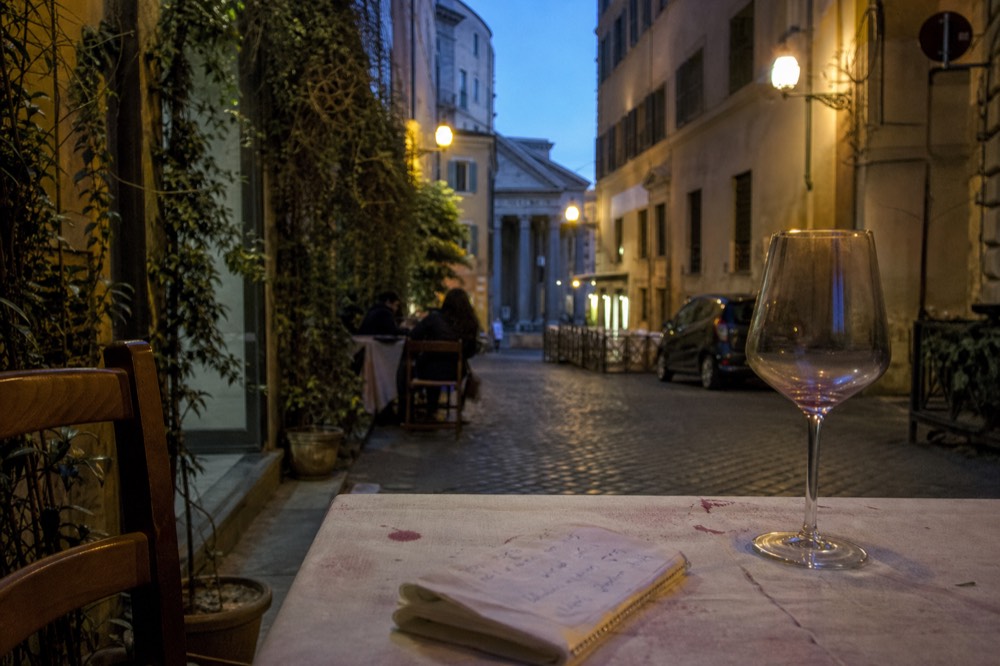
The venues that do this well make the whole subject boring, which is the compliment. Armando al Pantheon, for instance, publishes its hours, its closing days and its online-only booking rule on its own site, and Armando al Pantheon takes bookings exclusively online, a mechanism described in detail in the hardest restaurant reservations piece. A room that is transparent about its booking system tends to be transparent about its price list too. The pattern is not a guarantee, but it rhymes.
The service-charge question also explains why the Roman answer to tipping cannot be imported from London or New York. In those cities, the tip is the waiter's wage, and not tipping genuinely harms a person. In Rome, the servizio, where it exists, is already a disclosed part of the price, and the tip is a gesture stacked on top of a compensated wage structure. Different system, different etiquette, different conscience.
What Do Romans Actually Leave?
Romans leave nothing, round the bill up, or leave small change, and the choice tracks the service rather than the total. Nobody computes a percentage. There is no Italian standard rate, because no Italian consumer association or trade body has ever published one as a norm, and any page that hands you a percentage as the Italian rule is inventing it. Small change means exactly that: coins, on the table, for the waiter.
The rounding habit is the most Roman of the three. A bill lands, the total is not a round number, and the diner hands over the nearest note above it and waves away the change, or leaves the change on the table. It is quick, it is proportionate to the meal, and it requires no arithmetic at the end of the evening. Small change for genuinely good service is the warmer version of the same gesture.
What it never is, in the Roman version, is an obligation with a floor. The waiter does not watch the table to see whether fifteen percent appears. The kitchen is not underpaid on the assumption that tips close the gap. A traveller who leaves nothing at all has not insulted anyone, and the strongest honest framing of the answer to this article's question is exactly that: not tipping in Rome is not rude, it is unremarkable.
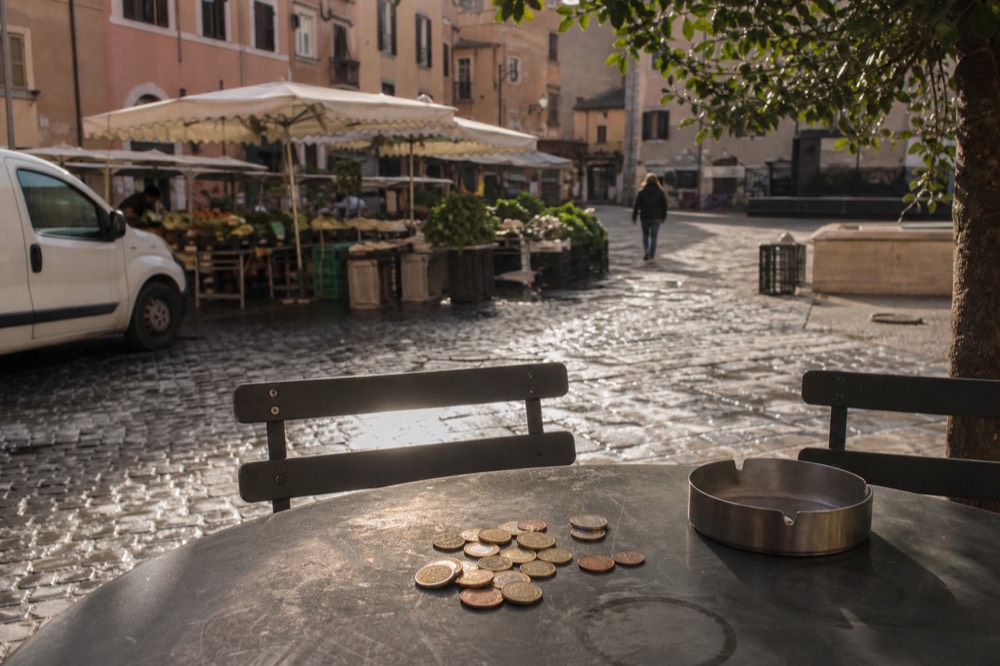
There is a texture to Roman generosity that the percentage habit flattens. Regulars tip differently from one-off tables. A barman who remembers your order gets the rounding treatment by the third visit. A trattoria where the family has been feeding the street for two generations will find the coins left for the waiter, not the house, because the gesture is personal, aimed at a person, not at an institution. That is also why the guided-tour exception exists, and it is coming up in two sections.
The three gestures have different shapes, and the table below is the practical summary of the Roman code: what each move signals, and when it is the natural one.
| The gesture | What it looks like | When it is the Roman move |
|---|---|---|
| Nothing at all | Pay the exact bill and leave | Ordinary service, anywhere from a bar counter to a trattoria, and nobody notices |
| Rounding up | Hand over the nearest note or coin above the total, wave away the change | The default warm gesture at a trattoria or pizzeria, no calculation involved |
| Small change | A few coins left on the table for the waiter | Genuinely good or personal service, or a regular's third visit to the same counter |
For the mechanics of the rest of the bill, the coffee and counter habits are covered in the eating in Rome on a budget guide, including how al taglio pizza pricing by weight works and why the bar's two posted prices are the lever you actually control.
How Does Rome Compare With The Rest Of Italy?
Rome is stricter than most of Italy on table charges, because the Lazio regional ban on the coperto has no equivalent in the regions travellers usually compare it with. Florence charges a coperto openly and lawfully. Naples and Milan each have their own habits. So the etiquette answer changes at the regional border, and a habit imported from Tuscany will misfire in Rome, where the charge you politely absorbed there is prohibited here.
This trips up the Italy-by-train traveller more than the first-time flyer, because the Florence leg of the trip teaches a rule that the Rome leg then contradicts. In Florence, the coperto line is normal, lawful, small and printed, and locals pay it without comment. Two hours of rail later, the same line on a Roman bill is a charge the restaurant should not be applying, and the polite response is a different one. Same word, opposite legal status.
The table below is the honest regional picture for the three charges this article separates, and it is the one to keep in your head if the trip covers more than one city.
| Region you are eating in | Coperto status | Servizio status | The tipping habit |
|---|---|---|---|
| Lazio, including Rome | Prohibited by regional law 21/2006, though some places charge it | Lawful only if shown on the price list before ordering | Nothing, rounding, or small change, never a fixed percentage |
| Tuscany, including Florence | Lawful, commonly charged and printed on the menu | Where charged, also disclosed | Rounding and small change; the coperto is not a tip |
| Elsewhere in Italy | Varies by region and by house | Varies; disclosure is the general rule | Optional throughout; no national percentage standard exists |
The comparison also settles a small argument people have at the table. Someone in the party will say the coperto is normal in Italy, because in Florence it was. Both halves of that memory are true and the conclusion is wrong. Italy's restaurant rules are regional, and the Lazio assembly voted to ban a charge that Tuscany still permits, which is why the honest answer to a Roman coperto line begins with the word actually.
When Is Tipping Actually Expected In Rome?
A guided food tour or cooking class is the one setting in Rome where travellers commonly do leave something for the person who ran the evening, though nothing obliges them to. Tour guides in Italy work in a gratuity-inclusive economy the way waiters do not, and the operator's price, fixed before you go, does not include a tip for the individual who ran it. Small change to rounding-up territory per person is the shape of the gesture.
This is not a loophole the tour industry invented. It is the logic of the Roman tipping habit carried to its honest conclusion: the tip follows a person and personal service, not a percentage of a bill. A waiter you saw three times over ninety minutes is compensated through the price of the meal, including any disclosed servizio. A guide who chose the counters, walked the route, poured the wine and answered questions for hours is a single person to whom your evening is attributable, and the Roman gesture for that is the coins on the table, scaled up.
The tour also solves the other half of the Roman evening, which this site documents at length: the reservation problem. No tour on the roster enters a famous restaurant, and none claims to. What a tour honestly does is remove the booking friction for one night and cover several counters in a single outing, at a price known before you fly, booked in advance like a ticket. For an evening where nothing on the bill can surprise you, that is the appeal.
The Trastevere street food walk with a local guide pairs food tastings with a sip of wine and beer, runs about two and a half hours in a small group, is rated 4.8 across 150 reviews (checked September 2026) on the operator's live listing, from $55.55 per person with free cancellation, and meets at the Basilica di San Bartolomeo all'Isola on the Tiber island. It is the compact version of the tipping-friendly evening: one guide, one route, one person to thank at the end.
If the budget is tighter or the format should be even shorter, the five fried tastings walk in the historic centre covers supplì, pizza, porchetta panini and fried artichoke in about two and a half hours, small group, rated 4.9 across 1,331 reviews (checked September 2026), from $51.10 per person, meeting by the fountain at Piazza di S. Simeone, with free cancellation available. The same gratuity logic applies: the guide is the person your evening belonged to.
Cooking classes sit in the same category for the same reason. A class where you made the pasta and ate it as a meal is run by an individual in front of you for three hours, and the fixed class price, from around $59 to $124 per person (checked September 2026) depending on format on the roster, books in advance. The tip question there has the same shape as the tour question, and the should I take a cooking class in Rome piece walks the decision (see Cooking Class Decision).
How Do You Handle The Bill Without Awkwardness?
Read the bill once before paying, identify which of the three lines you are looking at, and match your response to it: no action for a price you were shown, a calm query for a coperto line, and coins or rounding if the service earned a gesture. Doing that takes ten seconds, needs no Italian beyond pointing, and removes the only real awkwardness, which is not rudeness but uncertainty about what you are even paying.
The mechanics help. A servizio line that was printed on the menu you read before ordering is part of the price: pay it, add nothing, leave nothing, and you have done the fully Roman thing. A per-person line labelled coperto or pane is the prohibited charge: the calm move is to query it at the desk, and most rooms remove it rather than debate a regional law with a customer. A clean bill with neither line is the common case, and then the only question is whether the evening earned the rounding gesture, which is yours alone.
Cash habits matter more than the tipping question in this city. Three well-known Roman venues are confirmed cash only, Boccione in the Ghetto, La Renella in Trastevere and Supplì Roma, and no wider claim about Roman trattorias being cash-only is supportable, so check the venue rather than the folklore. The walking habits matter too: in Rome it is against the city's public-order regulation to sit down, including to eat, on monuments, fountains and their steps, so the pizza you just bought gets eaten on a bench or standing, not on the edge of a fountain.
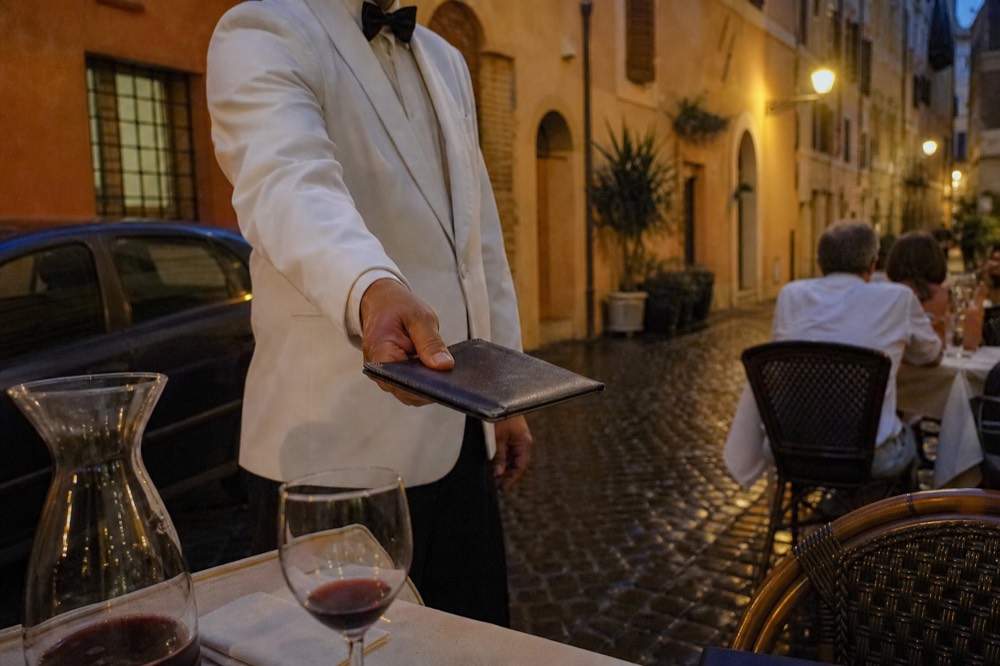
The rooms where the bill is simplest are the ones that publish their rules. Da Enzo al 29 takes no bookings at all, its own site says so plainly, and Roscioli takes online bookings only with a card held as guarantee, both of which are policies stated by the venues themselves. A restaurant that is explicit about its booking mechanism tends, in the Roman pattern, to be equally explicit about its price list, and the whole coperto question tends not to arise.
For the one genuinely awkward case, the starred kitchens, the mechanics are different again and the tip is the least of it. Il Pagliaccio publishes its own no-show terms on its booking page, a charge per person for a late cancellation, and that is the tier of Roman dining where the card guarantee, the closure calendar and the two-month book do the work that the tip question does not. The finer points of that tier are in the Michelin star restaurants in Rome guide.
The short answers: not tipping is not rude, the coperto is prohibited in Lazio, the servizio is lawful only when shown before you order, and the one place a tip is genuinely expected is a guided food tour. Below, the same questions travellers actually type, answered plainly, with the full reasoning available in the sections above each one.
Common Questions About Tipping In Rome
Is It Rude To Not Tip In Rome?
No. Tipping is optional and not expected in Rome. Italians commonly leave nothing, round the bill up, or leave small change for genuinely good service, and no percentage is the Italian standard. Not tipping is unremarkable, not an insult.
Is The Coperto The Same As A Tip?
No, and in Rome it is not even a lawful charge. A per-person coperto is prohibited in Lazio under regional law 21/2006, article 16. The lawful alternative is the servizio, a service percentage that must be shown on the price list before you order.
Should I Tip On Top Of A Servizio Charge?
No extra tip is expected. Where the servizio is properly disclosed before you order, it is the service charge and the staff are compensated through it. Coins for outstanding service are welcome but entirely your call.
Do Waiters In Rome Rely On Tips To Live?
No. The wage structure is not built on the assumption that gratuities close a gap, which is why the Roman tip is a gesture rather than an obligation. This is the key difference from tipping cultures where not tipping genuinely costs a worker money.
When Should I Actually Tip In Rome?
The one case where a tip is genuinely expected is a guided food tour or cooking class, where one named person ran your whole evening. The fixed price booked in advance does not include a tip for that individual, and rounding up is the natural gesture.
How Do I Handle A Coperto Line On My Roman Bill?
Query it calmly, citing the Lazio regional ban, and most rooms remove it rather than argue. Or pay it and note it, since enforcement is thin. What you should not do is treat it as an automatic gratuity and stack a percentage tip on top of it.
The three charges, the ban, the one exception: that is the whole map. For an evening where none of the questions arise, the walks below are the fixed-price answer, and for everything else on the table, coins or nothing, whichever the evening earned. That is the Roman rule, and it was never rude.