How To Tell If A Restaurant In Italy Is A Tourist Trap?
A method page: the checkable signals that mark a tourist trap in Rome and Italy, the streets where they cluster, and what to do instead, with no business named.
A tourist trap is not a matter of price alone, and it is never a matter of one named business (see Trastevere Trap Test). Two dated guides to Rome describe the same checkable signals: a menu laminated into four or more languages with a glossy photograph of every dish, a host stationed outside calling you in, and a carbonara made with cream. Those signals cluster on specific streets. This page sets out the method, the streets, and what to do instead, without accusing anyone, because the sourcing describes patterns, not restaurants.
How To Tell If A Restaurant In Italy Is A Tourist Trap?
The pattern shows in the printed materials and the doorstep before you order: a laminated menu in four or more languages with a photo on every dish, someone paid to pull you in from the pavement, classic dishes advertised with ingredients that do not belong in them, and fish prices quoted per etto in small print. Each signal is checkable from outside, and together they predict a menu built for traffic rather than repeat trade.
That is the honest method, and it is slower than most listicles admit. You read the menu, you look at the door, you watch who is eating inside, and you check whether the prices are stated plainly or by weight in fine print. A dated Rome guide names four areas where these signals concentrate: within two blocks of the Trevi Fountain in any direction, the porticoed edge of Piazza Navona, via della Conciliazione by the Vatican, and the belt around the Colosseum entrance. Zones, not names. The same guide adds a plain test that travels well: if the menu is translated into four or more languages and every dish comes with a photo, that is the signal, wherever in Italy you are standing.
The signals are learnable but they take a few visits to feel automatic, which is why the method has a shortcut. A guided tasting walk outsources the judgement to someone who eats on these streets for a living, covers several counters in one outing, and costs a price fixed before you go. For travellers with only two or three dinners in the city, that is often the better trade.
The three walks above span the range: a five-tasting historic centre walk, a two-and-a-half-hour Trastevere street food tour with a local guide, and a ten-plus tasting group tour with wine pairings. All three are booked like tickets, in advance, and none of them promises entry into a famous restaurant. What they remove is the guessing.
What Are The Checkable Signs At The Door?
Six signs are visible before you sit: a tout calling you in, a menu in many languages, a photograph on every dish, carbonara advertised with cream, fish priced per etto in the small print, and a laminated fixed tourist menu. Any one alone is weak evidence; two or three together, near a honeypot monument, is the pattern. The response is the same: keep walking.
The tout is the fastest read. A Roman trattoria that relies on regulars does not station a person outside to call you "amico" and gesture you toward a table. That role exists for rooms whose trade is one-time visitors, and a dated guide lists it as one of the clearest tells. The host outside calling people in is a giveaway precisely because it costs the restaurant money: it only pays when the food does not bring anyone back.
The menu is the second read, and it is the one you can do from the pavement. A laminated card in five languages with a glossy photo of every dish is built to be pointed at, not read. The traditional carbonara recipe uses pasta, guanciale, pecorino romano, egg and black pepper, with no cream, and a kitchen advertising it with cream is telling you it is cooking for an imagined visitor rather than for the dish. Fish priced per etto, per hundred grams, in small print at the bottom of the page is the last of the printed signals: the number looks small until the arithmetic lands on the bill.
There is a second layer that takes a minute longer. An all-afternoon kitchen in the centre, serving the same menu at four in the afternoon, is serving a mostly foreign trade; an Italian press report quotes centre restaurateurs describing exactly that clientele. A room where nobody is speaking Italian at eight in the evening is not proof of anything by itself, but on a street that already shows two printed signals it finishes the picture. And the inverse is true: a room full of Italians eating off a short, undecorated card is the strongest counter-signal there is.
| Signal | What it usually means | What to do instead |
|---|---|---|
| A host outside calling you in | The kitchen depends on one-time trade, not repeat trade | Keep walking two streets away from the monument |
| Menu laminated in four or more languages | Prices and dishes built for visitors who will not return | Look for a short printed card, daily and undecorated |
| A photograph beside every dish | The menu is pointed at rather than read | Choose rooms with a written menu, ideally handwritten |
| Carbonara advertised with cream | The kitchen is cooking a tourist version, not the dish | Check the menu's classics before you sit down |
| Fish priced per etto in small print | The stated number is per hundred grams, not per dish | Ask for the total weight and price before ordering |
| Serving all afternoon in the centre | The room serves a mostly foreign, all-day trade | Plan around Italian hours: lunch and a dinner reopening |
The table is a method, not a verdict on any address. Every one of these signs can appear in an otherwise decent room, and a room with none of them can still disappoint you. What the signals reliably predict is a menu engineered for people who will never come back, and that is the thing most travellers are trying to avoid.
What Not To Order In Italy?
Order badly and you hand an indifferent kitchen its easiest evening: cream carbonara, photographed dishes, fish priced by the etto without a stated weight, and any all-Italy menu stretching across six regions. Order well by anchoring to the regional canon: in Rome, the four pastas, the seasonal vegetables and the fried starters. The dishes that define a region are the hardest to fake.
In Rome the canon is unusually sharp, which makes it a good filter. Carbonara, cacio e pepe, gricia and amatriciana share one spine: guanciale or pecorino or both, and almost nothing else. The registered traditional specification for amatriciana excludes garlic, onion and pork belly outright, and the same exclusions hold for carbonara in the traditional recipe. A menu that gets these wrong is not being creative, it is cutting corners, and corners cut on the visible dishes are cut everywhere.
Fish deserves its own sentence anywhere in Italy. It is the category where per-etto pricing bites hardest, because a figure that reads as a dish price is a per-hundred-gram price, and the printed weight is in the small print. The honest rooms state the weight and the price together, or price the dish outright. If neither is visible, ask before ordering, in any city from Rome to Palermo.
The last bad order is subtler: ordering the exotic in the wrong region. A "typical Italian" menu that stretches from northern risotto to Sicilian cannoli in one laminated card is describing a warehouse, not a kitchen. The good version of Italian eating is aggressively local, and the shorter the distance between the menu and the market, the better the meal tends to be. For the Roman version of that canon, the what to eat in Rome guide walks the four pastas and the offal tradition dish by dish.
| Skip it | Why | Order instead |
|---|---|---|
| Carbonara with cream | The traditional dish has guanciale, pecorino, egg and pepper only | Any of the four Roman pastas, made to that canon |
| A photographed dish | The photo exists to be pointed at by visitors | Whatever the waiter names first off the card |
| Fish with no stated weight | The price per etto is in the small print | Fish with weight and price printed together |
| An all-Italy menu | No kitchen does six regions well | The three dishes this region is known for |
| The laminated fixed menu | It is built for traffic, not for the season | The daily specials, ideally handwritten |
If reading menus this way sounds like work on your second night in the city, that is the honest limit of the method. The signals are learnable, but slowly. The ten-plus tasting walk with wine pairings solves it differently: it is the longest tasting list on the roster, runs about 3 hours in a standard group from Piazza Mastai, and covers more than ten Roman tastings at a price fixed before you go, so nobody at any stop is deciding what to order from a card you have never read.
Italian Food Taboos That Mark A Kitchen
Certain orders are taboo in Italy not as etiquette but as evidence: cappuccino after a meal, parmigiano on a fish pasta, and balsamic drizzled over everything are the three visitors ask for most, and a kitchen that offers them unprompted is advertising which trade it cooks for. A room that declines them politely is telling you the same thing in reverse.
The taboos are real but they are softer than the internet makes them. Milk drinks belong to the morning in Italian habit, cheese does not meet fish, and balsamic is a Modena product, not a table condiment. Asking for any of these marks you as a visitor, which is fine, and a good restaurant will bring you what you asked for without comment. The useful signal runs the other way: a menu that puts cream in the carbonara, offers cappuccino through dinner and tops every plate with the same vinegar has optimised for visitors in every paragraph, and the taboos are simply where that optimisation becomes visible.
A second set of habits matters more to the bill than to the palate. Rome's own law on table service, regional law 21 of 2006, requires the price list to be available before you order and forbids a separate coperto charge outright, which makes an unannounced per-head charge on the final bill a thing you can question rather than a custom you must absorb. A lawful servizio may appear, but only where the list shows it before you order. That single mechanic, printed before you sit, is one of the best filters on the whole page, and it is why Best Restaurants in Rome treats the price list, not the food, as the first thing to check.
There is also a street-level taboo that carries a real fine band rather than a social frown. Sitting down on Rome's monuments, fountains and their steps, including to eat or drink, is prohibited by the city's public-order regulation, and patrols do enforce it around Piazza di Spagna, the Trevi Fountain and Piazza Navona. The rule matters here because the trap belt and the honeypot monuments are the same streets: the rooms nearest the view are the rooms with the most incentive to run a visitor menu. Two blocks in any direction, the calculus changes.
Which Roman Streets Gather The Most Tourist Menus?
Four zones concentrate the signals in Rome: within two blocks of the Trevi Fountain in any direction, the porticoed edge of Piazza Navona, via della Conciliazione approaching the Vatican, and the belt around the Colosseum entrance. A dated guide places the photo menus and the touts there because those streets have the foot traffic and almost no repeat local trade. Five minutes off any of them changes the menu you are handed.
The Trevi belt is the strongest case, because the fountain now draws a paid-entry perimeter and tens of thousands of visitors a day, a scale no neighbourhood kitchen can absorb honestly. The rooms in that radius price and print for people who will pass once. The Navona porticoes add the view premium: a table that faces the square sells the square, and the menu underneath it is priced and simplified accordingly. Via della Conciliazione runs a pilgrim and visitor stream toward St Peter's, and the Colosseum belt runs the tour-group stream. In each case the trade is one-time, and one-time trade is what the signals feed on.
The counter-pattern is just as checkable. Walk two blocks off Piazza Navona into the back streets and you reach rooms that take online bookings only and hold a card against the table, like Roscioli Salumeria con Cucina, whose own site states that reservations are online only with a card required as a guarantee. Or walk into Trastevere's back lanes and reach a trattoria like Da Enzo al 29, whose own site says plainly that it takes no reservations at all, in any service, and seats people in the order they arrive. Neither is a guarantee of a perfect dinner. Both are proof that the booking mechanism itself tells you which trade a room cooks for: rooms built on repeat business either refuse bookings and queue you, or book you properly with a guarantee, and neither behaviour is the behaviour of a trap.
One caveat keeps this section honest: no business on any of those streets is named here as a trap, because the sourcing describes patterns, not restaurants, and this site will not convert a street-level pattern into an accusation. The zones are a starting map, not a blacklist.
What To Do Instead In Rome?
The alternative to the trap belt is a city where roughly half of the best eating places have no booking mechanism to fail at: markets, bakeries, gelaterie, coffee counters, deli counters and wine bars, all walk-in. Eat where the food is weighed, cut or poured in front of you, and the question of a tourist menu never arises, because there is no laminated menu to read.
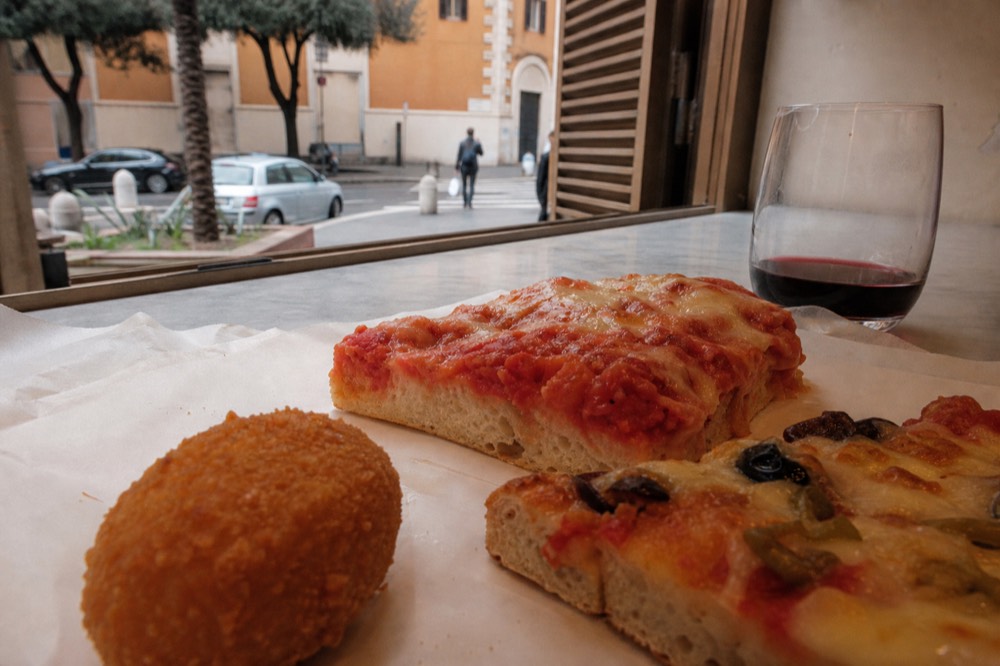
The counter-first half of Rome is the strongest answer on this site. At a pizza al taglio counter the piece is cut to the size you point at and weighed, so the price follows from the weight and the posted per-kilo card, not from a waiter's discretion. At a market stall like Mordi e Vai inside Nuovo Mercato Testaccio, whose official page states Monday to Saturday 07:00 to 15:30, the sandwich is made in front of you at a stall with a queue of locals, and the market's own page acknowledges the line without embarrassment. At a deli like Volpetti the cheese is cut to order at a counter. None of these places can be a trap in the menu sense, because none of them has a menu to engineer.
The trattoria half answers the question differently, through the booking mechanism. A room with a thirty-day online book released at midnight, a room that wants six hours' notice, a room that takes telephone bookings and refuses same-day requests, all of these are rooms managing demand, which is what rooms with local demand have to do. That is the opposite problem to the tout on the pavement, and it is a good problem to have. The where locals eat in Rome guide lays out those neighbourhood rooms, and the eating in Rome on a budget guide covers the counter mechanics, coffee, pizza by weight and the free drinking fountains, in full.
| Instead of | Go to | Why it answers the trap question |
|---|---|---|
| A piazza-facing dining room | A pizza al taglio counter | The piece is weighed in front of you from a posted card |
| A laminated menu near a monument | A covered market, such as Testaccio | Official hours, stalls cooking in view, no menu to fake |
| A tout at the door | A trattoria that refuses bookings | It queues everyone in arrival order, locals included |
| A fixed tourist menu | A deli or salumeria counter | Food cut to order at a counter price |
| A photograph-per-dish card | A neighbourhood gelateria or enoteca | One product, made in front of you, no printed menu at all |
For travellers who want the counter-first half of Rome without doing the street-level research, the five fried tastings walk through the historic centre is built for exactly that: a small-group format of about 2.5 hours, meeting at the fountain in Piazza di S. Simeone, covering suppli, pizza, porchetta panini and fried artichoke, with free cancellation available on the live listing.
Can A Guided Tasting Outsource The Judgement?
Yes, and for a short trip it is often the rational choice. A guided walk does not get you into a famous restaurant, and no honest listing claims it does; what it does is move the menu-reading, the street-choosing and the ordering onto someone who does it daily, across five or ten counters in one outing, at a price fixed before you leave. Free cancellation makes the decision reversible, which no trattoria table is.
The mechanics are worth stating plainly. The walks on this site are small-group or standard-group formats, run 2.5 to 4 hours, and the prices, ratings and review counts for each are printed in the comparison tables on this page. Every one of them offers free cancellation. None of them visits the famous trattorias, and that is not a weakness: the reservation problem at those rooms, the midnight release, the six-hour notice, the card guarantee, is exactly what a walk sidesteps by eating at counters and neighbourhood venues instead.
The honest close of the method is this: the signals are learnable, but slowly, and a first-time visitor applying them on night two will make mistakes a local would not. A guided tasting buys the judgement for an evening. The 2.5-hour Trastevere street food tour with a local guide, rated 4.8 across 150 reviews (checked September 2026), meets at the basilica on the Tiber island and includes food tastings with a sip of wine and beer, is the format that does it most cheaply in that neighbourhood.
Between them, the two walks above and the ten-plus tasting group tour in the cards below cover the historic centre, Trastevere and the longer format. Whichever you choose, book it before dinner on the day, read the cancellation terms on the live listing, and let the guide carry the method for one evening.
The questions below cover the method in the order travellers usually hit it: what the signals are at the door, what not to order, which Italian food habits mark a kitchen rather than a visitor, what the local law says about charges on the bill, and how a guided walk fits into the same judgement. Each answer keeps to the checkable patterns and names no business.
Common Questions About Spotting A Tourist Trap In Rome
How To Tell If A Restaurant In Italy Is A Tourist Trap?
Read the door and the menu before you sit: a tout calling you in, a laminated card in four or more languages with a photo on every dish, carbonara advertised with cream, and fish priced per etto in small print are the checkable signals. Two or three together, on a street within two blocks of a honeypot monument, is the pattern. Keep walking two streets and the trade changes.
What Not To Order In Italy?
Skip cream carbonara, photographed dishes, fish with no stated weight, all-Italy menus that span six regions, and fixed laminated tourist menus. Order the regional canon instead: in Rome, the four pastas made to their traditional recipes, the seasonal fried starters, and whatever the waiter names first off the card.
Is It Rude To Order Cappuccino After Dinner In Italy?
It is a habit marker, not an offence. Milk drinks belong to the morning in Italian custom, and a good kitchen will bring you one without comment. The useful signal is a menu that offers cappuccino through dinner unprompted, which suggests a room optimised for visitors in every paragraph.
Can A Coperto Charge On The Bill Be Questioned In Rome?
Yes. A per-person coperto is banned in Lazio by regional law 21 of 2006, and any lawful servizio must be shown on the price list before you order. A charge that appears unannounced is the violation, not the custom, so the price list is the thing to check before you sit down.
Do Food Tours In Rome Avoid Tourist Traps?
They outsource the judgement rather than the risk. A guided walk does not enter the famous trattorias; it covers several counters and neighbourhood venues in one outing at a price fixed in advance, with free cancellation on the listings in this category. For a two-dinner trip that is usually the better trade than learning the signals yourself.
Which Roman Streets Have The Most Tourist Menus?
The four zones are the two blocks around the Trevi Fountain in any direction, the porticoed edge of Piazza Navona, via della Conciliazione by the Vatican, and the belt at the Colosseum entrance. These streets have the foot traffic and almost no repeat local trade. Five minutes off any of them changes the menu you are handed.