Is Trastevere A Tourist Trap?
Which Trastevere streets run on tourist trade, which blocks still cook for the neighbourhood, and how to tell the difference by menu, door and clock.
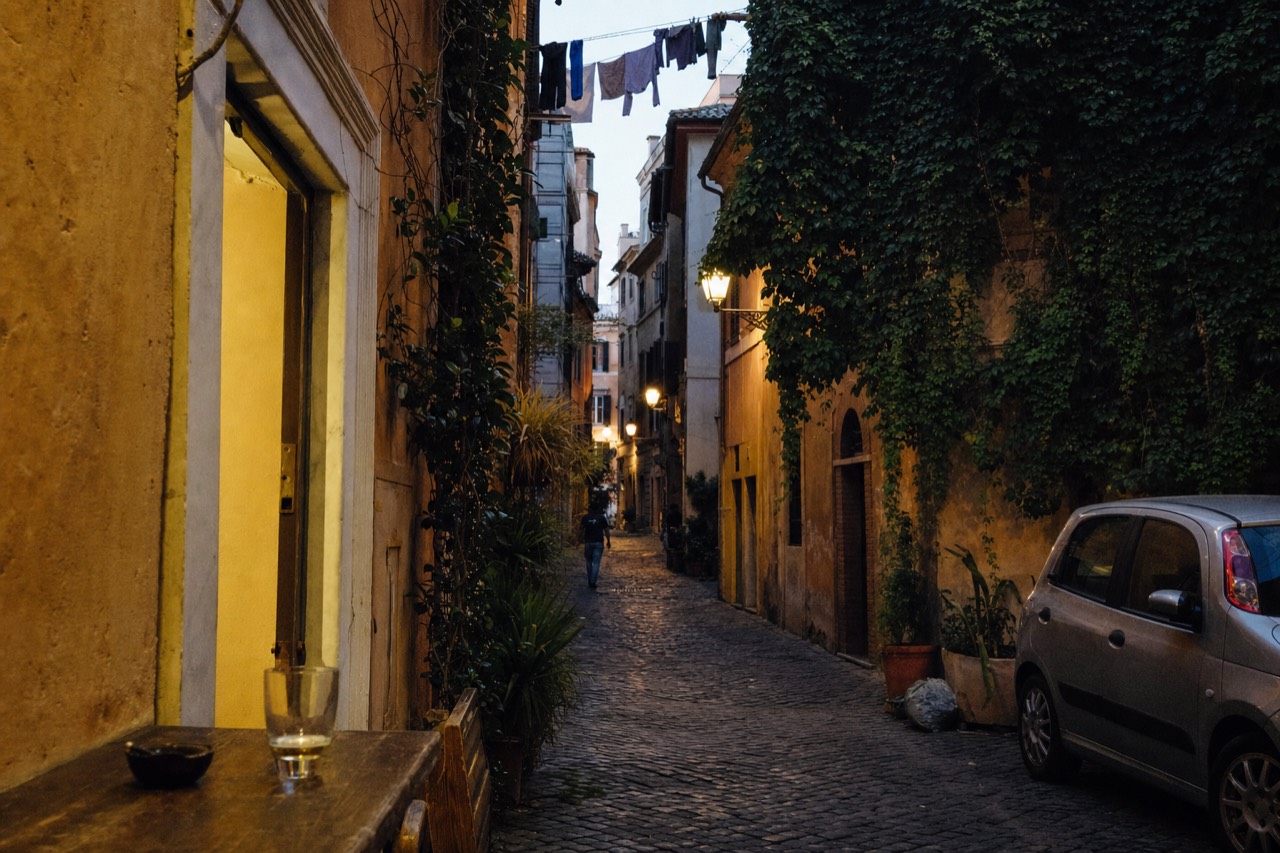
Trastevere is the quarter where the two Romes sit closest together. The same few lanes hold a bakery that has sold pizza by weight to neighbourhood families for decades, a gelato counter with a queue of locals, and a restaurant with a laminated menu in five languages and someone at the door whose job is to stop you walking past. Calling the whole quarter a trap is lazy and wrong. Calling it all authentic is equally wrong. The split runs street by street, and after dark it moves.
This page maps the split: which squares and lanes run on visitor trade, which two or three blocks do not, what changes late in the evening, and the concrete signals that tell you which side of the line a doorway is on. It draws on the booking policies, queues and walk-in habits of twenty-nine of the sixty best-known Roman tables and counters, including the Trastevere records for Da Enzo al 29, Tonnarello, La Renella and the counters around them. No business here is named a trap: the pattern is the street, not any single menu. For the wider frame, how to spot a tourist trap restaurant covers the tells that apply across Italy, and the Rome street food guide covers what to buy at the counters instead.
Is Trastevere A Tourist Trap?
No, not as a whole; it is better asked street by street. The quarter's front line, Piazza di Santa Maria in Trastevere and the lanes feeding it, trades heavily on visitor traffic, with the menu and door tells to match. Two and three blocks deeper, the trattorias, bakeries and counters that refuse reservations and queue locals, Da Enzo al 29 and Tonnarello among them, keep serving the neighbourhood. The balance tips toward the tourist side after about 21:00.
The geography of the problem is specific. Trastevere's honeycomb of cobbled lanes funnels almost everyone toward one square, Piazza di Santa Maria in Trastevere, and the streets that drain into it, particularly via della Lungaretta and the stretch of via del Moro nearest the square. High footfall plus high rent plus a transient customer base is the economics that produces a photo menu and a tout at the door. The same forces, one block north or south, thin out enough that ordinary businesses survive on regulars.
That is why the resident population matters to the answer. Trastevere never emptied the way some historic centres did. It is one of the few central quarters where Romans still live, shop and argue in the queue at the bakery, and that resident base is what keeps a genuine trattoria economy alive next to the visitor one. A quarter with no residents has no reason to run a counter that sells pizza by weight, or a friggitoria that closes on Sunday because its customers are at home.
The evening shift is the part first-time visitors miss. Early evening, before 19:30, the quarter is mixed: market shoppers, couples on the standard sunset walk, locals heading to dinner. From about 21:00 the balance tips. The trattorias that cook for Romans have served most of them by then, the bars on the river-facing lanes fill, and the lanes around the basilica become largely a visitor crowd. The food that is still easy to find late is counter food, gelato and pizza al taglio, not a table.
A fixed-price walk removes the guesswork from the evening, because the stops are chosen before you arrive and the price is set in advance. Three that cover Trastevere from different angles:
The three differ in shape more than in quality. The local-expert walk is the short, cheap one; the twilight walk is the long, wine-led one; the Ghetto crossing is a private walk that starts across the river. All three keep their meeting points inside or beside Trastevere, and all three carry free cancellation.
Which Trastevere Streets Run On Visitor Trade?
The problem streets are the ones within roughly two blocks of Piazza di Santa Maria in Trastevere: via della Lungaretta between the square and Ponte Sisto, the nearest stretch of via del Moro, and the riverside lanes around Piazza Trilussa. There, footfall supports businesses built for one-time customers. Via della Lungaretta on the Santa Maria side is the epicentre. The deeper blocks toward via San Francesco di Sales and the Viale stay closer to ordinary neighbourhood trade.
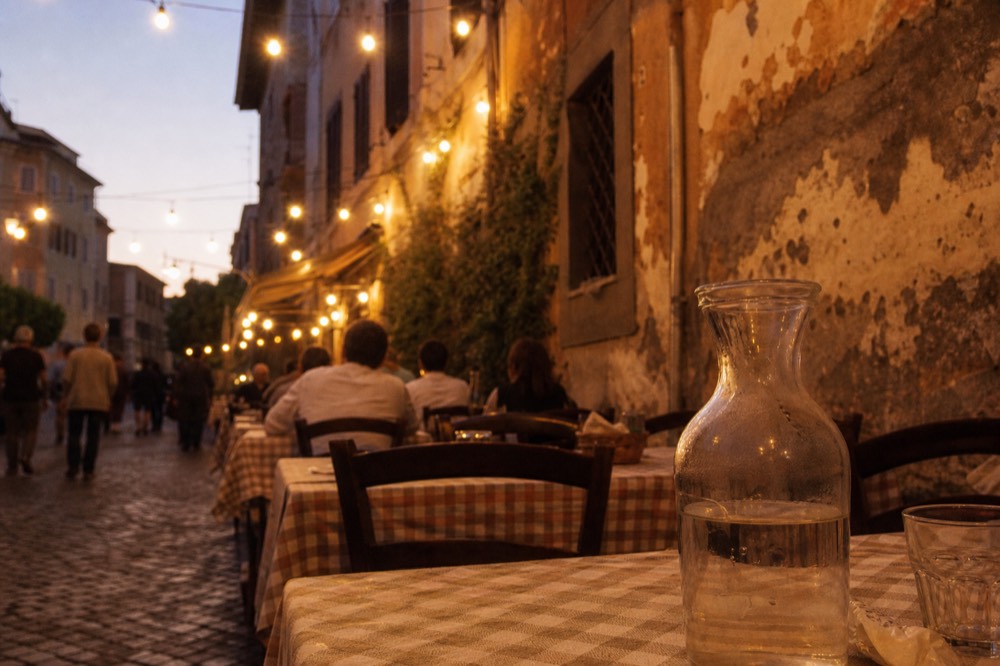
What the front-line streets look like, and what to do about each:
| Zone within Trastevere | What it is aimed at | What to do there |
|---|---|---|
| Piazza di Santa Maria in Trastevere and its café terraces | The sunset-and-basilica view; tables priced for it | Look at the basilica, drink if you want the seat, eat elsewhere |
| Via della Lungaretta, square to Ponte Sisto | Impulse dinners: one-time customers, menus in several languages | Walk it for the atmosphere, cross-check menus for the trap tells below |
| Via del Moro nearest the square | Similar trade, thinner footfall | Useful cut-through; the further from the square, the saner the menus |
| Piazza Trilussa and the riverside lanes | Evening drinking, groups, the post-dinner crowd | Fine for a drink; the food options are aimed at convenience, not cooking |
| Streets north of the church toward via della Scala | Mixed: some visitor trade, real shops and counters | Good hunting ground for bakeries and friggitorie |
| Back blocks toward via San Francesco di Sales | Mostly residents and neighbourhood trade | Where the tables locals actually use are |
The pattern generalises beyond Trastevere too. The same dated guides that describe these lanes describe equivalent belts elsewhere in the centre: the porticoed edge of Piazza Navona, the blocks around the Trevi Fountain in any direction, and via della Conciliazione by the Vatican. The common factor is never the neighbourhood, it is a monument-adjacent street where rent and footfall reward a business model that does not need a second visit.
The counterweight is that a street being touristy does not make every doorway on it bad. A bakery on a busy lane can still be a real bakery, because bread and pizza al taglio sell to whoever is passing and do not depend on a return customer. The tables are where the economics bite hardest. A sit-down menu is the thing worth inspecting.
What Are The Actual Signs Of A Trap Doorway In Trastevere?
Four tells carry the weight: a laminated menu translated into four or more languages with a photo of every dish, a host outside calling people in, a carbonara advertised with cream, and fish or other items priced per etto in small print. Each is a business model signal, not a quality verdict. A place showing several at once is built for one-time customers. A place showing none, with a printed Italian menu and nobody at the door, is not.
The photo menu is the strongest single signal. Photographing every dish is expensive and it exists to sell to people who cannot read the menu, which means the kitchen expects a customer base that does not read Italian. The language count matters the same way: a genuine Trastevere trattoria may offer a translated insert, but a menu laminated into five languages is a different product.
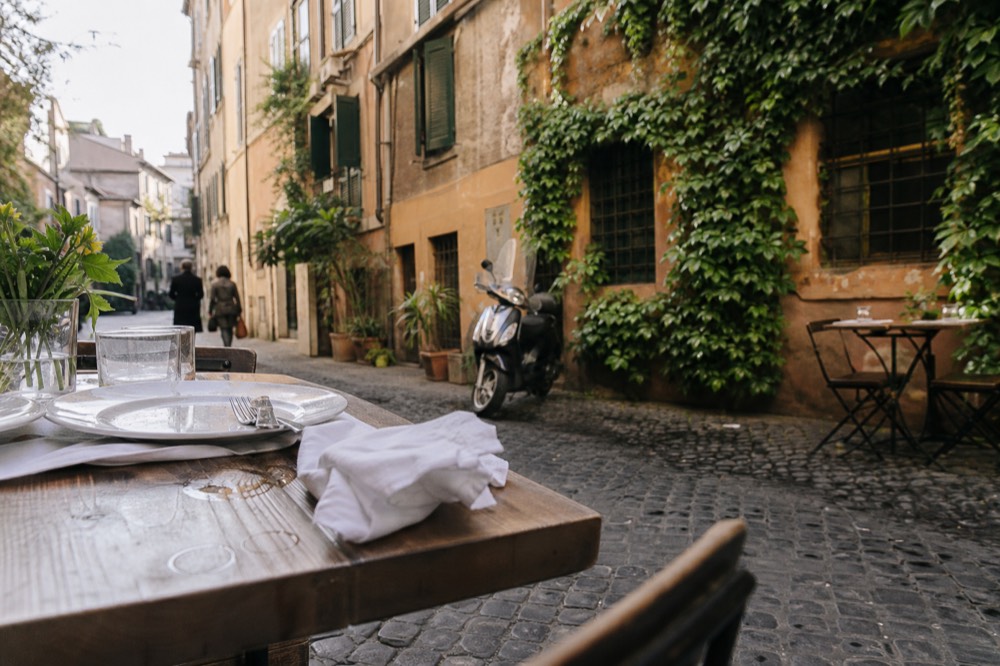
The tout is the second. Roman dining culture does not station a person outside the door to pull passers-by in. A host whose job is footfall conversion tells you the kitchen is competing for people who have never heard of it and never will again. Combined with the photo menu, it is close to conclusive.
The cream carbonara is the local-food signal, and it is specific enough to be useful. The traditional recipe is five things: pasta, guanciale, pecorino romano, egg and black pepper. Cream in a carbonara on a Trastevere menu means the kitchen is cooking a version invented for a foreign palate, which is a choice, and it tells you which palate the rest of the menu is aimed at.
| Signal on the doorway or menu | What it tells you | How strong it is |
|---|---|---|
| Laminated menu in four or more languages | The customer base is one-time and non-Italian | Strong on its own |
| Glossy photo of every dish | Selling to people who cannot read the menu | Strong, and usually paired with the above |
| Host outside calling customers in | Competing for footfall, not regulars | Strong |
| Carbonara with cream listed | Cooking for a foreign palate | Reliable food signal |
| Fish or specials priced per etto, small print | The bill is the surprise; the menu price is not the plate price | Reliable pricing signal |
| All-afternoon continuous service | A mostly foreign trade, since Roman kitchens close between lunch and dinner | Moderate, not conclusive |
The per-etto pricing needs one explanation, because it is legal and it is not a scam, but it catches visitors. Some Roman menus price fish or some specials by weight, per hundred grams, in smaller print. The listed number looks like a plate price and is not. Read the unit, ask what a typical portion weighs, and the trap closes.
One more honest note: none of these tells names a business, and this site does not. They are patterns attached to streets and doorways. Applying them to the two blocks of via della Lungaretta closest to the square will match several doorways; applying them on the back streets will match almost none.
Reading menus on a dark lane is work, and it is exactly the work a guided walk takes off your plate. If that trade sounds worth it to you, the box below is the short version.
Where Do Romans Actually Eat In Trastevere?
In the walk-in half of the quarter. Da Enzo al 29 takes no reservations in any service and seats people in arrival order; Tonnarello refuses bookings at all five of its addresses; and the bakeries and counters, La Renella, Supplì Roma, Biscottificio Innocenti, Otaleg, run on no booking mechanism at all. Most of the quarter's best-known tables sit at the low end of the friction scale: you queue briefly or not at all.
Da Enzo al 29 is the cleanest case, because the trattoria explains its own policy on its own site: a small room, plates cooked to order, guests seated in arrival order, and no reservations, full stop, lunch or dinner. Da Enzo al 29 states it plainly. A dated review describes a line out the door, and no reliable wait in minutes exists, so none is printed. Arrive before the door opens or expect to stand.
Tonnarello is the same policy scaled up. Tonnarello takes no bookings by phone or email at any of its five Trastevere rooms and tells you so on its own site, advising patience and avoiding peak hours. Dated diner reports put the wait at forty minutes at peak dinner, and over an hour in one report. That is the price of a room that refuses to manage a book.
| Trastevere venue | What it is | How you get a table or a bag |
|---|---|---|
| Da Enzo al 29 | Small trattoria, rigatoni alla carbonara | No bookings at all; line up, doors at 12:00 and 18:30 |
| Tonnarello | Trattoria, tonnarelli with the four Roman sauces, five rooms | No bookings; walk in, avoid peak dinner hours |
| La Renella | Wood-oven bakery, pizza by weight, cash only | Walk in, point at the tray |
| Supplì Roma | Fried rice balls at a counter, cash only, closed Sundays | Walk in, order, eat in the street |
| Otaleg | Gelateria, open to midnight and later on weekends | Walk in any evening |
| Biscottificio Innocenti | Biscuit workshop, biscuits sold by weight | Walk in |
The counters are the other half of the answer. Pizza al taglio works on a scale: you point at the size of the piece you want, it is cut, weighed, and the price follows from the weight. Supplì are fried to order and bought one at a time. None of these transactions has a reservation, a cover charge dispute or a translated menu with photographs. It is the part of Trastevere that works exactly as a neighbourhood's food infrastructure should.
The walk-in half also answers the trap question by a different route: prices fixed on a board, portions you can see before you pay, and a queue of locals in front of you. For where this pattern repeats across the city, where locals eat in Rome maps the equivalent counters in other quarters, and Rome neighbourhood dining compares the quarters directly.
A guided walk that starts from the counters is one way to short-circuit the whole decision. The Local Guide, Wine and Beer walk runs about two and a half hours in a small group, with food tastings and a sip of wine and beer along the way, from $55.55 per person (checked September 2026), rated 4.8 across 150 reviews, meeting at the Basilica di San Bartolomeo all'Isola on the Tiber island. Cancellation is free.
What Changes In Trastevere After Dark?
The tourist share of the quarter rises sharply from about 21:00. Roman dinner service runs from roughly 19:00 or 19:30, so by nine the trattorias have served much of their local trade and the kitchens that cook for residents are winding toward 22:30 closing. What fills the lanes afterward is the bar and evening crowd, concentrated near Piazza Trilussa and the river, and the food still easy to find is counter food rather than a table.
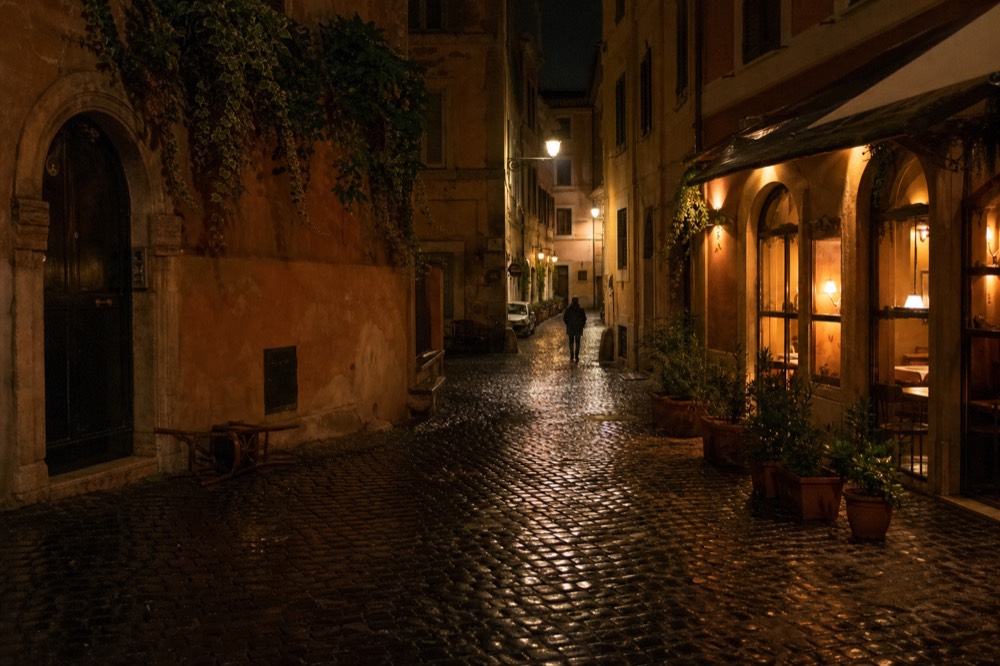
The clock matters because the trap signals get stronger as the evening trade takes over. The menus that rely on photos and hosts work best on the late crowd, people who have finished their sunset walk and want a table now. Earlier, the 19:00 to 20:30 window, the trattorias are running their resident service, and a door with a line outside it at 19:15 is the inverse signal: a place that does not need to attract anyone.
Practical reading: if you want the neighbourhood's food, eat early by Roman standards, 19:30 to 20:30, and if you want the quarter's famous evening atmosphere, do it after dinner with a gelato or a drink rather than with a table booked at the worst hour on the worst street. Gelato and the pizza counters run to midnight and later in parts of the quarter, which suits the late plan better than any restaurant does.
Alcohol rules also bite late, and they apply in the zones listed in the city's public-order regulation, not just where the crowds are. Between 22:00 and 07:00 you cannot drink anything from a glass container in the street, and between 23:00 and 07:00 you cannot drink alcohol in the street at all, in any container. The practical version: the takeaway cup you are handed exists because of this rule, and the rule is enforced.
One more late-evening mechanic worth knowing is the coperto, because Rome is the inverse of the generic-Italy advice. A separate cover charge is prohibited in Lazio under regional law 21/2006; what restaurants may lawfully add is a servizio, and only if the price list shows it before you order. If a bill carries an unexplained per-head charge, that is the dispute to raise, calmly, with the price list in hand.
Should You Still Eat In Trastevere, Or Cross The River?
Yes, eat there, with your eyes open. The quarter holds some of the most reliably documented walk-in eating in central Rome, including trattorias that refuse every booking and counters with prices on a board. The failures are concentrated in a specific, avoidable zone: the two blocks nearest Piazza di Santa Maria in Trastevere and the riverside lanes after 21:00. Skipping Trastevere entirely means skipping the good half to avoid the bad two blocks.
If the aim is a table without decision fatigue, the longer walks solve it differently. The Twilight Walk, Wines Included runs about four hours in a small group from Piazza S. Bartolomeo All'Isola 22, six to seven curated tastings through Trastevere with local wines poured along the way, from $123.12 per person (checked September 2026), rated 4.9 across 6,343 reviews, with free cancellation. It is the longest wine-led tasting format on this site's Trastevere roster.
Alternatively, cross the river. The Jewish Ghetto, one bridge away, holds its own kitchen, carciofi alla giudia and a kosher bakery with a permanent queue, and the Ghetto crossing walk covers it as a private tour with pickup available, three or five tastings depending on the option, from $52.26 per person (checked September 2026), rated 4.8 across 168 reviews, meeting at Piazza Benedetto Cairoli. It reads Trastevere and the Ghetto as one walk, which is how the two quarters actually fit together.
The full comparison of the quarter's other tables, both the hard ones and the walk-in ones, sits in the Trastevere dining overview on the neighbourhood guide, and the question of whether a walk is worth it at all is argued out in are food tours in Rome worth it (see Bourdain's Rome Tables). For the deeper background on every restaurant named on this page, the parent site, Best Restaurants in Rome, covers booking policies, walk-in lists and where the queues are. The short version of the tour question: a tour does not get you into a famous trattoria, none of the listed walks visit the restaurants named on this page, but it does remove the reservation problem and cover several counters at a price fixed before you go.
Whichever route you take, the three-card summary below holds the quarter's three formats side by side, and every listing on it can be cancelled free if the evening turns a different way.
Trastevere is not a trap as a quarter, but two blocks of it behave like one. The questions below cover the specifics: which streets carry the visitor trade, how the walk-in trattorias handle the crowd, what the night-time rules are, and where the residents actually queue. Each answer points back to the street-by-street method above.
Common Questions About Trastevere
Is Trastevere A Tourist Trap?
Partly. The two blocks around Piazza di Santa Maria in Trastevere and the riverside lanes after 21:00 run largely on visitor trade, with the photo menus and door hosts to match. The rest of the quarter, including trattorias that take no bookings and counters with prices on a board, still serves residents. Judge street by street, not quarter by quarter.
What Is The Best Street To Avoid In Trastevere?
There is no street to avoid, only doorways to read. Via della Lungaretta between the basilica square and Ponte Sisto carries the heaviest visitor trade, but it also connects the quarter's two halves. Walk it, and apply the menu tells: four or more languages with photos, a host calling you in, cream in the carbonara.
Do Any Trastevere Restaurants Take Reservations?
The famous walk-in ones do not. Da Enzo al 29 takes no reservations in any service, and Tonnarello refuses bookings at all five of its rooms. Roma Sparita, elsewhere in the quarter, does book, through its own site, opening the book fifteen days out. Mixed policy is normal here.
Is Trastevere Safe To Walk At Night?
Yes, in the ordinary urban sense: it is a busy, residential, central quarter with heavy footfall late. The night-time rules to know are the city's public-order ones, which apply in the zones listed in the regulation: no drinking from glass containers in the street between 22:00 and 07:00, and no street drinking of alcohol at all between 23:00 and 07:00.
Where Do Locals Eat In Trastevere?
In the walk-in half: the no-booking trattorias like Da Enzo al 29 and Tonnarello, and the counters, La Renella for pizza by weight, Supplì Roma for fried rice balls, Otaleg for gelato late. Arrive at the Roman dinner hour, 19:30 to 20:30, rather than at 21:30, when the local trade is largely served.