Rome Street Food: What To Eat Without A Reservation
Half of Roman eating involves no booking, no waiting list and no card guarantee: a counter, a queue of minutes rather than weeks, and food you eat standing or walking. This guide covers the four Roman street foods worth crossing the city for and how each of them is actually sold.
Short answer
Rome's street food canon is pizza al taglio sold by weight, supplì fried to order, the trapizzino pocket of pizza bianca, and pizza bianca straight from a forno oven. None of it takes a reservation. Counters like Pizzarium, Supplì Roma, La Renella and Trapizzino serve walk-ins only, and street food walks run from $48.37 per person (checked September 2026).
Half of the sixty best-known Roman tables and counters covered on Best Restaurants in Rome take no booking of any kind, and the street food half is the easiest of all: counters, forni and market stalls where a reservation is not a thing that exists. This is the natural companion to the site's sit-down canon. Where the trattorias run thirty-day books and midnight release times, the friggitoria runs on the order in front of you.
That contrast is the whole idea of this page. Pizza al taglio is cut and weighed in front of you (see Best Pizza In Rome). Supplì are fried in batches and bought one at a time. The trapizzino is a pocket of bread filled with a stew, made to be eaten with two hands. None of it needs planning beyond knowing which counter and which closing day.
What Street Food Is Rome Known For?
Rome is known for four street foods: pizza al taglio, sold by weight and cut with scissors; supplì, fried rice croquettes with a molten mozzarella centre; the trapizzino, a triangular pocket of pizza bianca filled with Roman stews; and pizza bianca, plain olive-oil bread sold hot from neighbourhood forni. All four are counter foods with no reservation and no table attached.
That list is shorter than the tourist-board version, and it is the honest one. The gelato cone and the espresso at the bar belong to the same walk-in world but have their own pages: the best gelato in Rome and the aperitivo guides cover them. Street food proper is the savoury canon, and it all comes from the same instinct: food a Roman can eat between two errands.
Two of the four are ancient in shape and modern in form. Pizza bianca has come out of Roman ovens for as long as there have been Roman ovens. The trapizzino, by contrast, is a recent invention, a pocket repurposing the old bread to carry the stews that used to need a plate and a fork. The old and the new sit side by side on the same counter, which is very Roman.
| Street food | What it is | How it is sold | Where it comes from |
|---|---|---|---|
| Pizza al taglio | Topped pizza baked in trays, cut to size | By weight, cut in front of you | Pizzarium, Forno Campo de' Fiori, La Renella |
| Pizza bianca | Flat bread with olive oil and salt, no topping | By weight from a forno | La Renella, Panificio Bonci, Forno Campo de' Fiori |
| Supplì | Fried rice croquette, mozzarella or ragù | One at a time at a fryer | Supplì Roma, Casa Manco, Pizzarium |
| Trapizzino | Pizza bianca pocket filled with a stew | Per piece, from a counter | Trapizzino, six Rome locations |
What Is Pizza Al Taglio In Rome?
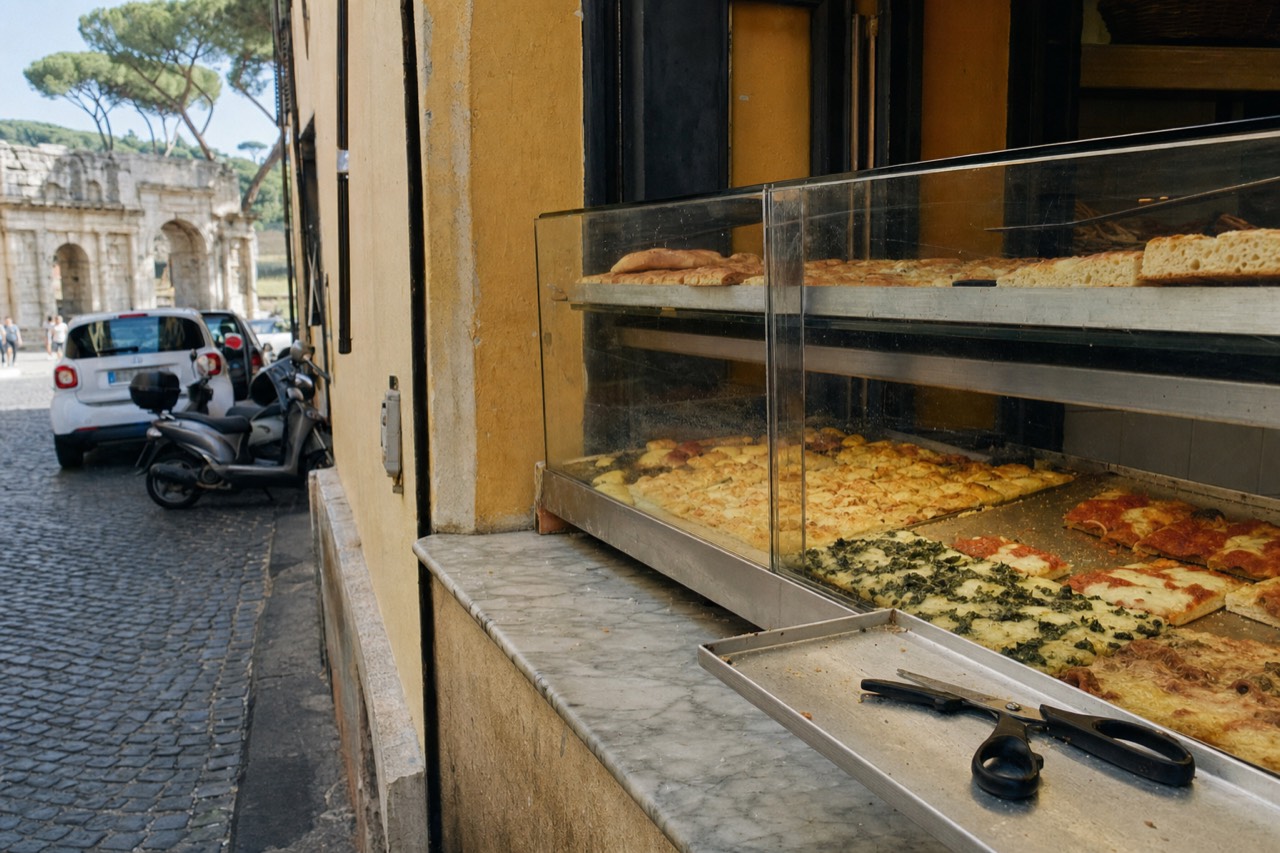
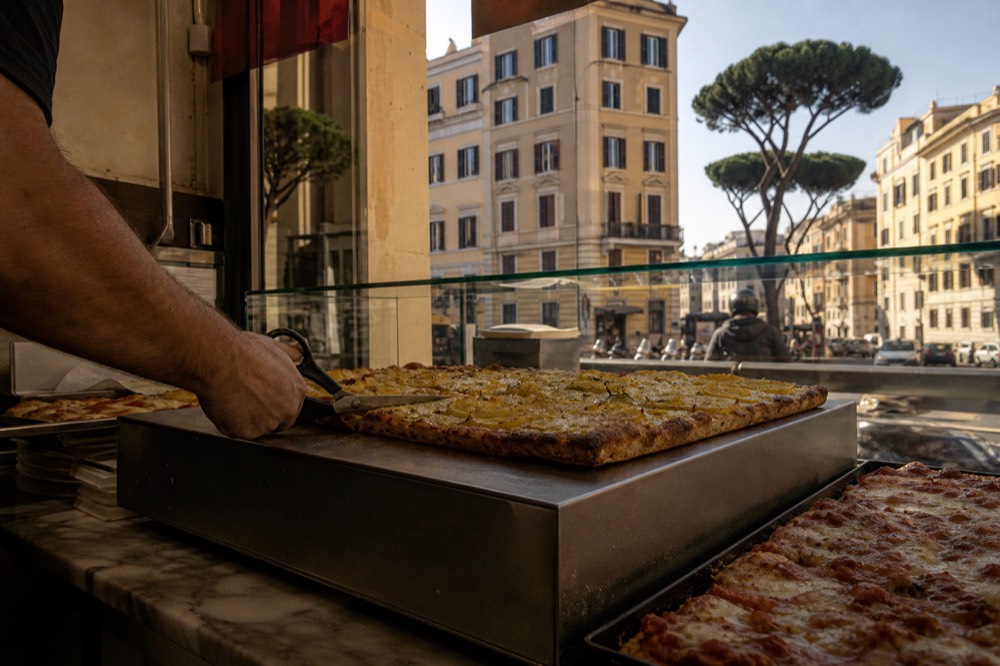
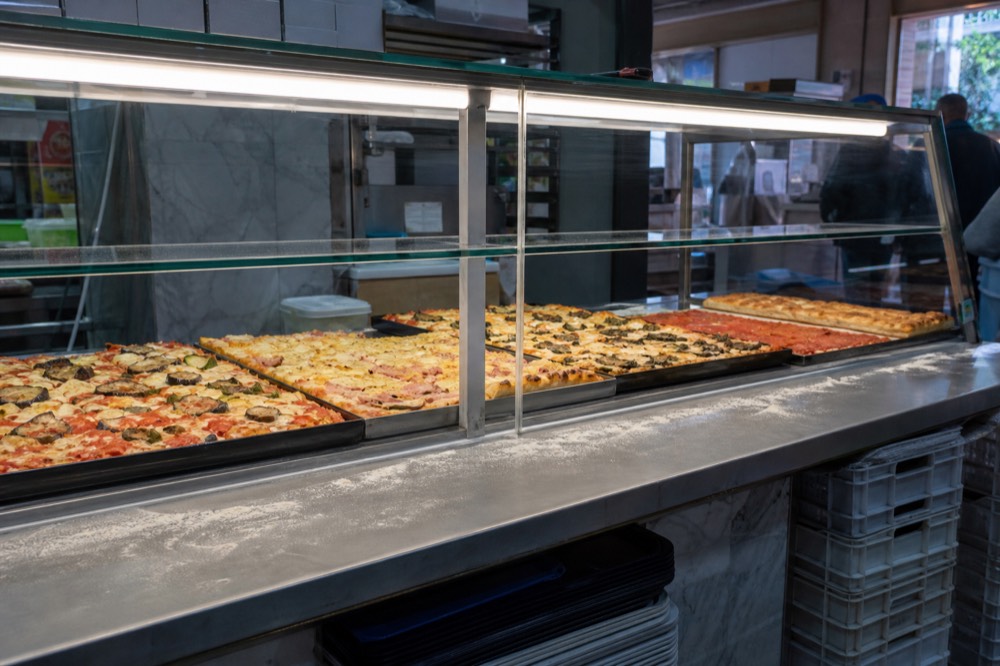
Pizza al taglio is pizza baked in large rectangular trays, displayed under glass, cut to the size you point at, weighed on a scale, and charged by weight. You do not order a slice, you indicate a piece, the counter cuts it with scissors or a blade, and the price follows from what the scale says. It is the standard Roman lunch, and the mechanic trips up visitors more than any language barrier does.
The confusion is understandable. A glass case of pizza looks like a slice shop, and slice shops the world over print one price per slice. In Rome, the price is per kilo, and every topping on the counter carries its own per-kilo rate at the same shop. A piece with potatoes costs more than a plain red one of the same size, because the rate is different, not because you were upsold. A minority of counters sell fixed pre-cut slices at a flat per-piece price instead, which is worth noticing: it is the one case where the cost is known before anything is cut.
How to order, step by step. Look at the trays, decide roughly how much you want, and point at the piece: the counter will cut exactly along the line your finger makes, so a generous gesture is a generous piece. It goes on the scale, the price follows, and you pay. Say "mezzo" for a half-tray-width piece or point at a smaller rectangle if the first cut looks too big. Nothing about this requires Italian beyond pointing, and Romans point too.
The width of the per-kilo spread across Rome's counters is real and printable: rates at the same counter vary by topping, and rates between counters vary widely. What that means in practice is that the same two hundred gram piece of pizza can cost meaningfully different amounts two streets apart. If a flat, knowable price matters to you, look for counters selling pizza by the piece, or ask "quanto viene?" before the scissors come out.
Where Is The Best Street Food In Rome?
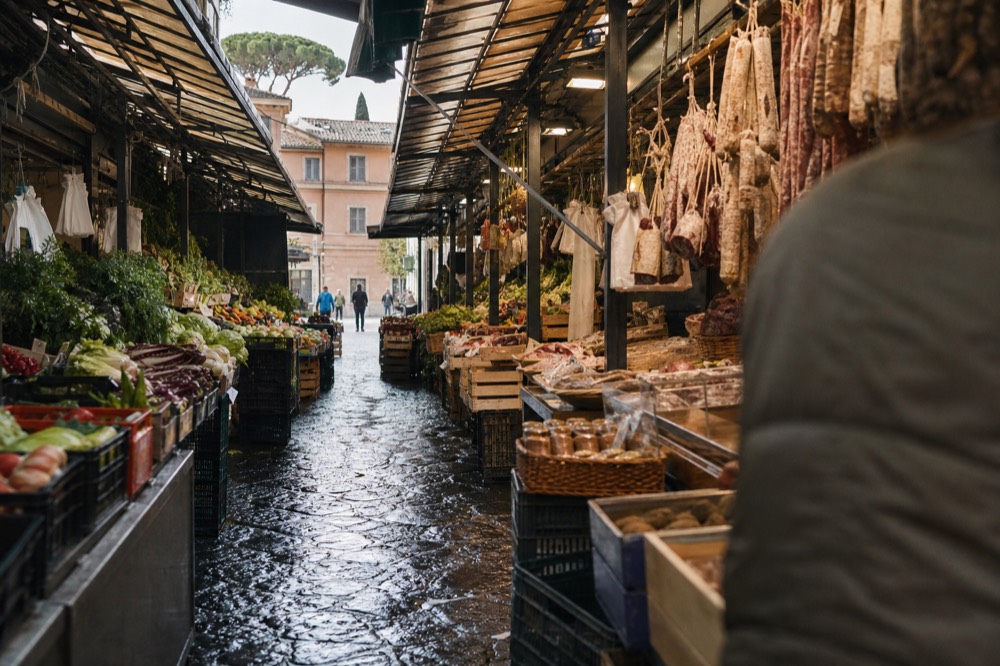
The best street food in Rome is concentrated in five zones: Testaccio's covered market and its surrounding counters, the bakeries of Campo de' Fiori and the Jewish Ghetto, the pizza al taglio counters of Prati around Pizzarium, the forni of Trastevere, and the Mercato Centrale food hall at Termini. Each zone has a closing pattern, and the closing pattern matters more than any ranking.
Testaccio is the deepest of the five. The Nuovo Mercato Testaccio keeps official hours of Monday to Saturday, 07:00 to 15:30, closed Sunday, per the market's own information page. Inside it, Casa Manco turns out pizza alla pala from box 22, and Mordi e Vai builds panini from boiled meat, with a queue the market's own stall page acknowledges. Across the neighbourhood, Volpetti sells Lazio cheeses and cured ham cut to order, a shop counter that closes Sunday with the rest of the quarter.
Prati holds the most famous single counter in the city: Pizzarium, Gabriele Bonci's pizza al taglio operation near the Vatican. It has no seats, no booking system and no table service of any kind. A dated diner report described more than ninety people waiting and two half-hour waits in a single visit. The bakery half of the Bonci operation, Panificio Bonci nearby, has no queue story attached to it at all and closes Sunday.
Trastevere and the Ghetto carry the fried and baked end. Supplì Roma is a friggitoria that is closed Sunday and public holidays and takes cash only. Pasticceria Boccione in the Ghetto is a kosher bakery, so it closes Saturday for Shabbat, is cash only, and its ricotta and sour-cherry tart sells out, Sundays first, per Gambero Rosso. La Renella is a wood-oven bakery in Trastevere where you point at a tray and pay by weight. And at Termini, the Mercato Centrale food hall runs every day on long hours, with artisan counters including fresh pasta, pizza and trapizzino under the old station terminal.
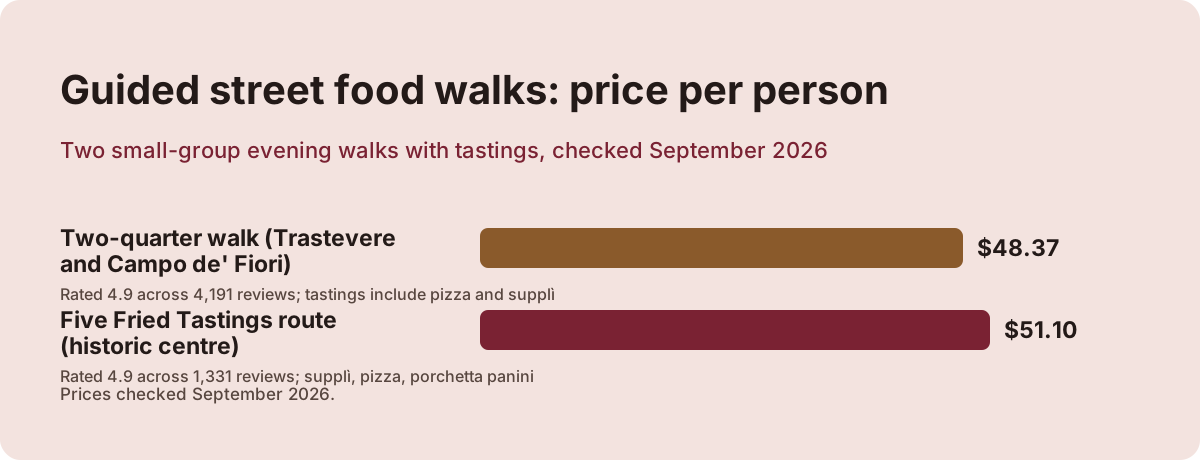
If the planning side of that still sounds like work, a guided walk is the shortcut. The 2.5-hour two-quarter walk is the cheapest way to cover Trastevere and Campo de' Fiori in one evening: from $48.37 per person (checked September 2026), rated 4.9 across 4,191 reviews, a small group, with street-food tastings including pizza, supplì, gelato and sandwiches, free cancellation, meeting at Fontana Piazza San Simeone.
For a walk that leans harder on the fried canon, the Five Fried Tastings route through the historic centre covers supplì, pizza, porchetta panini and fried artichoke in one loop, from $51.10 per person (checked September 2026), rated 4.9 across 1,331 reviews, a small group of about 2.5 hours, meeting at Piazza di S. Simeone by the fountain, with free cancellation throughout.
What Is Supplì In Rome?
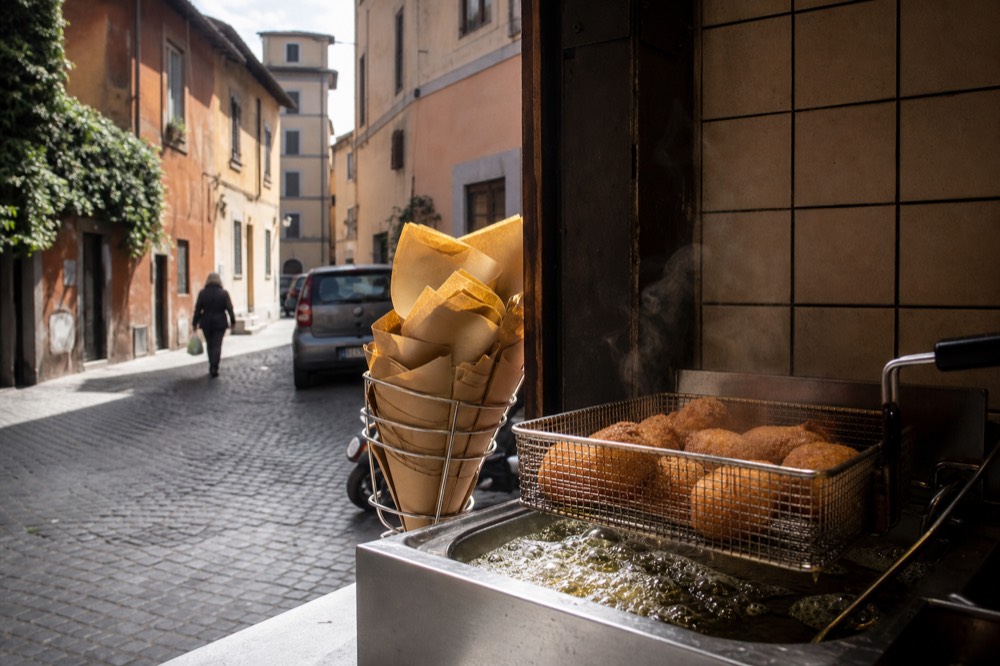
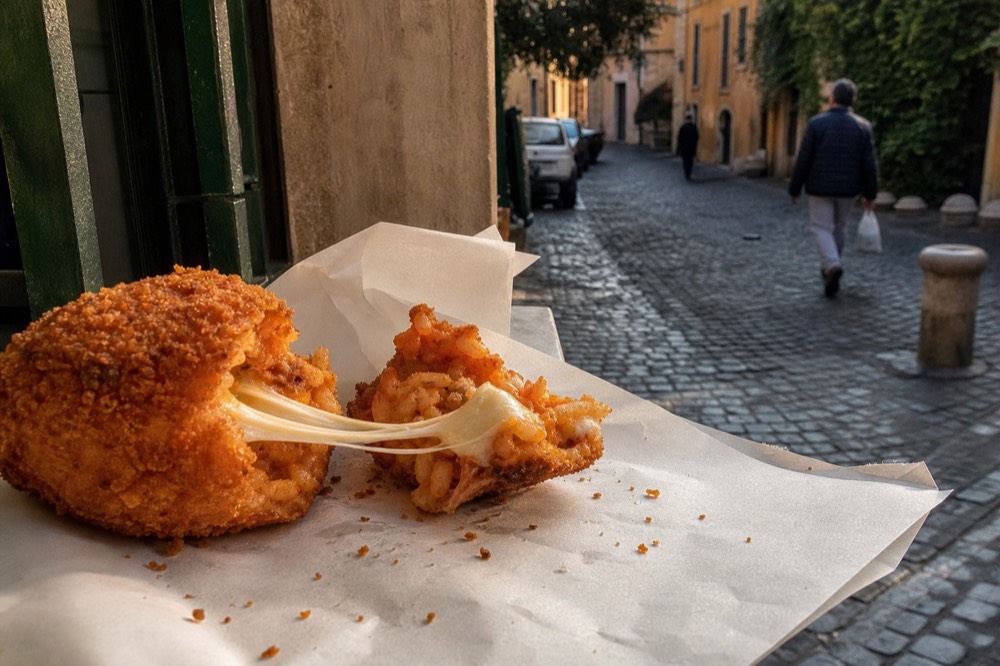
A supplì is a Roman fried rice croquette: rice bound with ragù or tomato, shaped around a piece of mozzarella, breaded and deep-fried to order, so that the cheese stretches in a long thread when you break the croquette open while it is still hot from the basket. Romans call the classic version supplì al telefono precisely because of that pull, the "telephone wire" of mozzarella between the two halves. It is not an arancino.
The distinction from the Sicilian arancini is one this site treats properly elsewhere: the Roman version is smaller, oval rather than round or conical, and the rice is looser, a croquette rather than a stuffed ball. The classic filling is a meat ragù; the mozzarella-centre version is the one that does the stretch. Both are fried in batches and sold one at a time at a counter, which is the whole pricing mechanic: there is no scale, no kilo rate, just a per-piece price posted at the till.
Where they are made well: Supplì Roma in Trastevere, a takeaway counter closed Sundays and public holidays, cash only, and easy to walk into any time it is open, with barely a queue at the counter. Casa Manco at box 22 of the Testaccio market sells its own supplì alongside the pizza alla pala. Pizzarium sells them too, which is one way to eat at the city's most famous pizza counter without the full ninety-person wait: a dated report describes visitors ordering supplì to blunt the hunger while queuing for the pizza.
The other half of the Roman fried canon is the fritto, and the Jewish Ghetto's carciofo alla giudia, the deep-fried whole artichoke, sits at the sit-down end of it. The street version of Roman frying is really the supplì and its cousins, bought at friggitorie like Supplì Roma and eaten within a minute of the basket. That immediacy is the point: a supplì is at its best for the first ninety seconds out of the oil, which no restaurant meal can deliver.
| Fried Roman food | What it is | Where the place itself places it | When that place is closed |
|---|---|---|---|
| Supplì al telefono | Rice croquette, mozzarella centre, cheese pull | Supplì Roma, Trastevere | Sunday and public holidays |
| Supplì al ragù | Rice croquette bound with meat ragù | Casa Manco, Testaccio market box 22 | Sunday, with the market |
| Fritti misti | Mixed fried starters, sit-down | Trattorias across the canon | Varies by restaurant |
| Carciofo alla giudia | Whole deep-fried artichoke | Nonna Betta, Jewish Ghetto | Tuesday |
Is Trapizzino A Must Try In Rome?
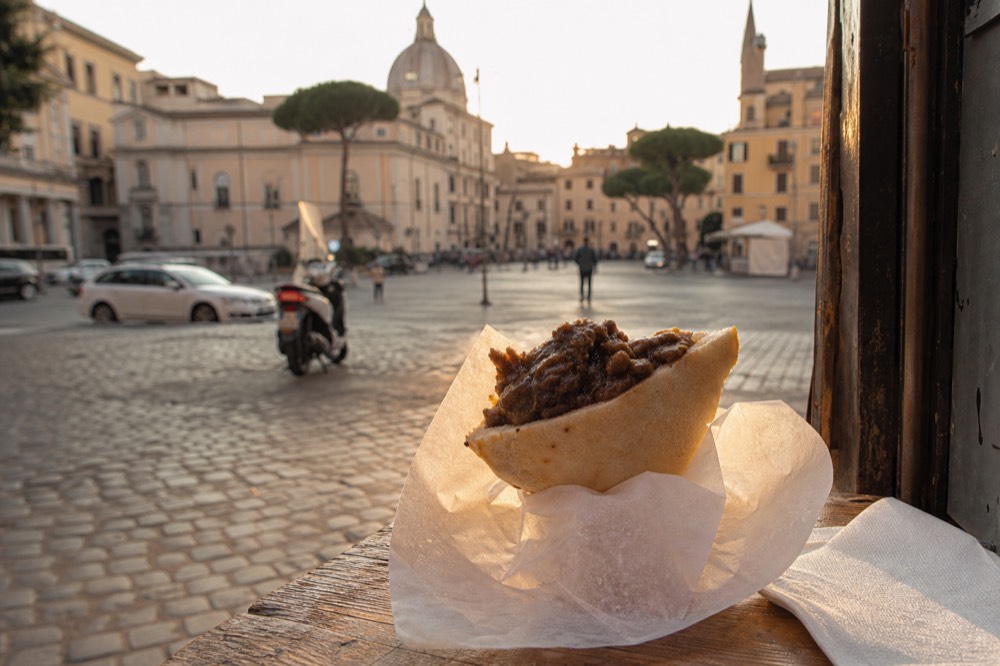
A trapizzino is a triangular pocket of pizza bianca, crisp at the points and soft in the middle, filled with a Roman stew such as pollo alla cacciatora or beef with tomato. It is the dish that turns the old bread into a container for the old trattoria cooking, and yes, it belongs on a shortlist of Roman street food worth trying. It is also genuinely new, which is unusual here.
The creator is Stefano Callegari, a pizzaiolo whose Testaccio counter started the format. The year of invention is disputed between sources, so no single year holds. What is printable: the Trapizzino brand now runs six Rome locations, plus others in Italy and New York, per a dated Esquire Italia report. The Testaccio branch, the original, is open every day from 12:00 to 23:00 with table service, per its own site: no booking mechanism involved in eating one.
The reason it earns its place is the filling. Roman stews, the pollo alla cacciatora and the braised beef that grandmother cooking has always produced, used to require a plate, a fork and a dinner hour. The trapizzino puts them inside bread you can carry, which means the quinto-quarto-adjacent flavours of Roman home cooking are available at a counter at any hour of the afternoon. That is not a gimmick, it is a repackaging of the canon, and Romans queue for it too.
The walk-in status of the whole category is worth saying plainly. The Trapizzino counters, the forni, the friggitorie and the market stalls in this guide take no reservation, hold no card, and charge nothing for a late cancellation because there is no booking to cancel. If the reservation mechanics of the sit-down canon, the thirty-day books and the card guarantees, are what you are avoiding, this is where to stand instead. The trade is that you eat some of it standing up, and Rome's street rules, covered below, have opinions about where.
| Trapizzino fact | What the detail actually is |
|---|---|
| Format | Triangular pizza bianca pocket, filled to order |
| Fillings | Roman stews: pollo alla cacciatora, beef with tomato, seasonal |
| Locations | Six in Rome, plus other Italian cities and New York |
| Original branch | Testaccio, open daily 12:00 to 23:00, table service, no booking |
| Creator | Stefano Callegari, a pizzaiolo, from a Testaccio counter |
Where Can I Find The Best Pizza Al Taglio In Rome?
The best pizza al taglio in Rome is found at Pizzarium in Prati, Casa Manco at box 22 of the Testaccio market, Forno Campo de' Fiori in the centre, Antico Forno Roscioli near Campo de' Fiori, and La Renella in Trastevere. Each one sells by the same mechanic, and each has a different character, so "best" is really a question of which queue you are willing to join.
Pizzarium is the famous one, and the fame is priced in queue-length, not in money: a dated report describes more than ninety people waiting. Forno Campo de' Fiori is the bakery on the market square, closed Sunday, with no ticketing system, so you track your own place in line or a regular takes it, per a dated travel report. La Renella is the Trastevere wood-oven bakery, cash only, where the filone and the pizza by weight share the counter. Antico Forno Roscioli is the bakery half of the Roscioli family business, the half you can simply walk into while the salumeria con cucina next door runs its online book with a card guarantee.
The Testaccio market deserves a special line for a reason no listicle usually gives: it is a lunch-only building. The market trades Monday to Saturday, 07:00 to 15:30, and that is the whole window. The counters inside it, Casa Manco and Mordi e Vai among them, finish before most visitors have started thinking about dinner, which is the friction nobody warns you about. The Rome food markets guide carries the full market-by-market detail.
| Counter | Neighbourhood | Sells by | The catch |
|---|---|---|---|
| Pizzarium | Prati, near the Vatican | Weight | No seats; a dated report of over 90 waiting |
| Casa Manco | Testaccio market, box 22 | Weight | Market shuts at 15:30, closed Sunday |
| Forno Campo de' Fiori | Centro Storico | Weight or piece | No ticketing, closed Sunday |
| La Renella | Trastevere | Weight | Cash only |
| Antico Forno Roscioli | Campo de' Fiori | Weight | Queue discipline is your own job |
Where Can You Actually Eat Street Food In Rome?
You can eat street food in Rome anywhere except the places protected by the city's public-order regulation, which prohibits sitting down, including to eat or drink, on monuments, fountains, the staircases attached to them and archaeological remains, and on the street, alleys and doorways where you block the way. The rule sits in article 4 of the Nuovo Regolamento di Polizia Urbana, and the full regulation text is published by Roma Capitale. Patrols do enforce it, so the fountain steps that look like picnic seating are not.
This matters to a street food itinerary more than to any other kind. A slice of pizza and a supplì are foods you eat while moving, and the city has opinions about where moving-with-food stops. The safe zones are the ones the regulation itself points to: spaces set up for eating, meaning the counter areas, the market halls, the benches away from monuments, and the steps that belong to nobody. The Trevi Fountain is the strictest case in the city: sitting, eating and drinking there are prohibited under a specific ordinance, and the inner perimeter now requires a paid entry ticket for non-residents.
The alcohol rules have hours attached, in the zones listed in the regulation. From 22:00 to 07:00 no takeaway alcohol may be sold at all, and from 22:00 to 07:00 nothing may be drunk from a glass container in the street. From 23:00 to 07:00 alcohol may not be drunk in the street in any container. For a street food walk that ends with a beer, that means finishing it before eleven, or drinking it seated at a proper bar, which the wine and aperitivo guides cover in detail.
The practical version: eat standing within sight of the counter you bought from, or walk to a bench, or sit at the tables the counter itself provides. A street food tour solves this as a side effect, since the guide's route keeps the group inside the permitted zones. For travellers who want a bridge between the counter canon and the sit-down canon, the where locals eat in Rome guide covers the trattorias that need a booking, and the what to eat in Rome guide covers the four pastas that come with a table.
| Rule | What it says | Where it applies |
|---|---|---|
| Bivacco ban | No sitting, even while eating, on monuments, fountains, their steps, and archaeological remains | Citywide, enforced by patrols |
| Street sitting | No sitting to eat on the street, in alleys or in doorways where you block the way | Citywide |
| Glass containers | No drinking anything from glass in the street, 22:00 to 07:00 | Zones listed in the regulation |
| Street alcohol | No alcohol in any container in the street, 23:00 to 07:00 | Zones listed in the regulation |
| Trevi Fountain | No sitting, eating, drinking or climbing; paid entry for the inner perimeter | The fountain itself |
Should You Learn To Make The Street Food Yourself?
A pizza or pasta class is the other way to eat Roman street food with zero booking friction at the table, and Rome's class roster runs from $41.33 per person upward, with free cancellation available on every listing throughout the roster. (checked September 2026) The two-hour pizza class near Piazza Navona, from $56.73 per person, rated 4.9 across 1,506 reviews, in a small group, puts a pizza you make and eat in front of you, with coffee, tea or limoncello. It meets at Osteria Pasquino on Piazza di Pasquino.
The cheapest entry on the whole roster is the pizza plus tiramisu class with flowing wine, from $41.33 per person (checked September 2026), rated 5 across 1,501 reviews, three hours, small group. Its listing publishes no meeting point. The choice-format class at the Towns of Italy cooking school, from $56.62 per person, rated 4.9 across 344 reviews, lets the group pick pizza or pasta and pours unlimited wine alongside gelato or sorbet, meeting at Via Quattro Novembre 139.
None of this replaces the counter, and it is not meant to. What a class does is explain the mechanics from the other side: why the dough is wet, why the oven has to be that hot, why the cheese pulls. It is also a bad-weather and closed-day fallback, since classes run on fixed daily schedules while the Testaccio market does not run on Sunday at all.
Putting The Walk Together
A street food day in Rome is a route problem, and the route is the whole plan: the counters open early and close early, the Testaccio market by 15:30, the forni through the morning and lunch, the friggitorie through the afternoon and evening, and the Trapizzino counters to 23:00. The reverse of the trattoria rhythm, in other words: street food is a morning and midday sport, with an evening second wind.
One shape that works, built on the market's published hours alone: the Testaccio market for the pizza at Casa Manco and a panino at Mordi e Vai, before 13:30, when the queues start. Then Trastevere in the afternoon, La Renella for pizza by weight and Supplì Roma for the fried course, both walk-in counters. Then a Trapizzino counter in the evening, any of them, since the original runs to 23:00 daily. The Termini food hall is the fallback that is open when everything else is shut, every day on long hours.
For travellers who would rather have the route handled, the three walks in the cards below cover the same ground with a guide, tastings included and the closing-day planning done. Free cancellation runs across all of them, so a date can be locked in early and adjusted when the rest of the itinerary settles.
Rome's street food canon is four dishes, four mechanics and a handful of counters, and the questions travellers ask about it are almost always about pricing, places or the rules on the street. The answers below pull together the practical details: what each food is, where the best versions are found, how the by-weight counter works, and where you may and may not sit down to eat it.
Common Questions About Rome Street Food
What Street Food Is Rome Known For?
Pizza al taglio sold by weight, supplì fried to order, the trapizzino pocket filled with Roman stews, and pizza bianca from a forno. All four are counter foods with no reservation involved.
Where Is The Best Street Food In Rome?
Testaccio's covered market, the Campo de' Fiori and Ghetto bakeries, the Prati counters around Pizzarium, the forni of Trastevere, and the Termini food hall. Each zone has its own closing pattern, which matters more than the ranking.
What Is Pizza Al Taglio Rome?
Pizza baked in large trays, displayed under glass, cut to the size you point at, weighed and charged by weight. Different toppings carry different per-kilo rates at the same counter, and a minority of shops sell flat pre-cut pieces instead.
What Is A Roman Pizza Al Taglio?
The Roman version is a high-hydration dough baked in trays with toppings that change through the day, cut with scissors or a blade and sold by the gram. It is distinct from pizza tonda, the round sit-down pizza, and from Neapolitan styles.
Where Can I Find The Best Pizza Al Taglio In Rome?
You'll find it at Pizzarium in Prati, Casa Manco in the Testaccio market, Forno Campo de' Fiori, Antico Forno Roscioli and La Renella in Trastevere. Expect the longest queue at Pizzarium and the earliest closing time in Testaccio.
What Is Supplì In Rome?
A fried rice croquette with a mozzarella or ragù centre, eaten hot from the basket. The mozzarella version, supplì al telefono, is named for the cheese thread that stretches between the halves. It is smaller and looser than a Sicilian arancino.
Is Trapizzino A Must Try In Rome?
Yes, if you want Roman stew flavours without a table. The pocket of pizza bianca filled with dishes like pollo alla cacciatora runs from a counter at six Rome locations, open daily with no booking mechanism.