The Best Pizza In Rome: Tonda, Al Taglio And Where To Eat Both
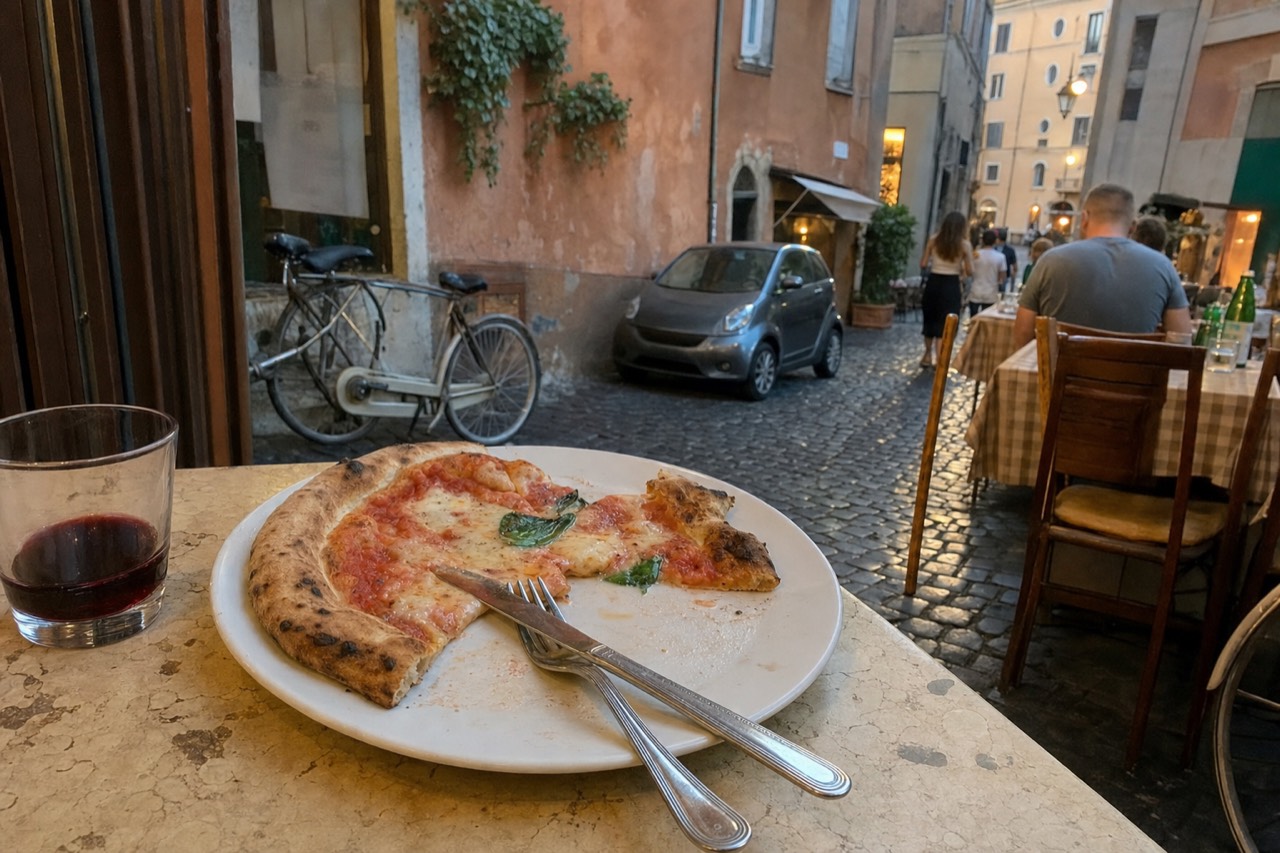
Two different meals share one word in Rome. Pizza tonda is a thin, cracker-crisp plate eaten sitting down in a pizzeria that often opens only in the evening. Pizza al taglio is a daytime slab cut and weighed at a counter. Confuse them and you will be standing outside a shuttered pizzeria at noon.
Short answer
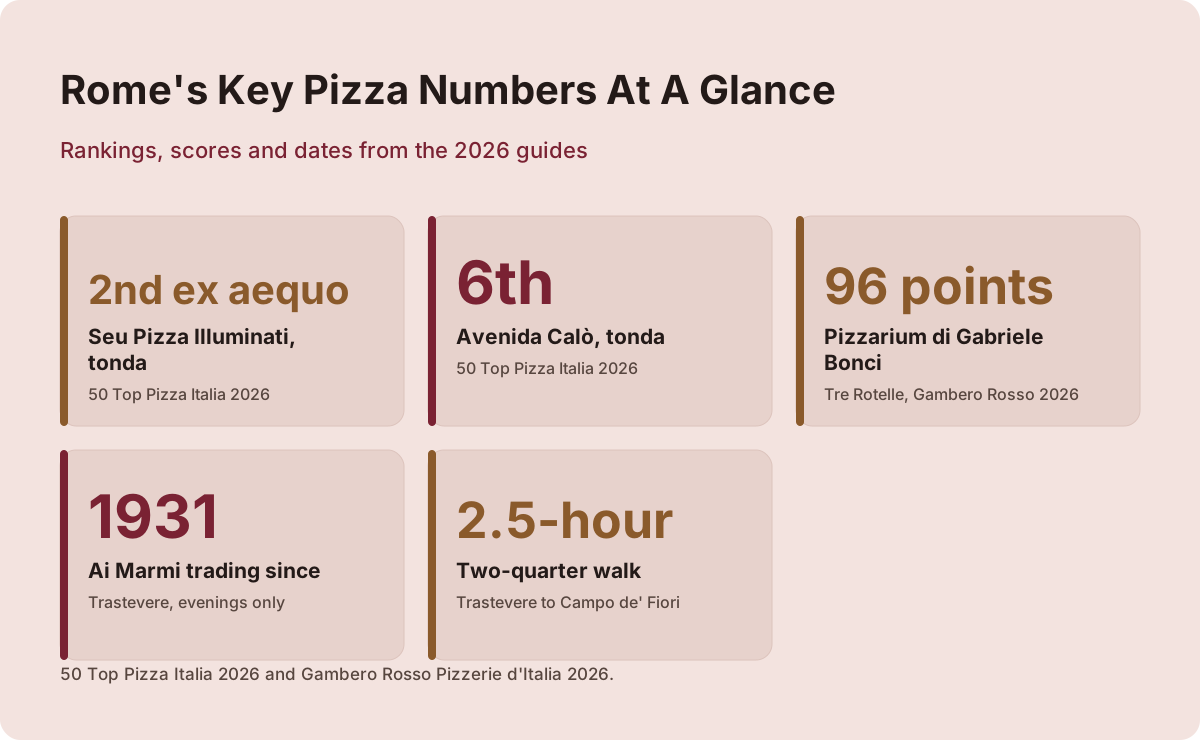
Seu Pizza Illuminati placed 2nd ex aequo in 50 Top Pizza Italia 2026 and Avenida Calò placed 6th, with Francesco Calò named Pizzaiolo dell'Anno 2026. For pizza al taglio, Pizzarium di Gabriele Bonci holds Tre Rotelle with 96 points in the Gambero Rosso Pizzerie d'Italia 2026 guide.
Two different meals share one word in Rome. Pizza tonda is a thin, cracker-crisp plate eaten sitting down in a pizzeria that often opens only in the evening. Pizza al taglio is a daytime slab cut and weighed at a counter. Order the wrong one at the wrong hour and you will be standing outside a shuttered pizzeria at noon, or queueing at a bakery at eight in the evening. This page separates the two, names the places each style is done well, and sets out the rules that govern how pizza is priced, cut and eaten in the city.
Rome's pizza culture rewards timing more than insider knowledge. The classic Roman pizzerie are largely walk-in-and-queue rooms rather than bookable ones, and the al taglio counters sell by weight rather than by the slice. Once you know those two mechanics, the rest of the planning falls into place. The rankings help too: the 2026 guides put two Roman kitchens near the top of the national list, and the al taglio champion has been scoring in the high nineties for years.
What Is Considered The Best Pizza In Rome?
The best pizza in Rome splits into two answers. For the sit-down round pie, 50 Top Pizza Italia 2026 placed Seu Pizza Illuminati 2nd ex aequo and Avenida Calò 6th, with Francesco Calò of Avenida Calò named Pizzaiolo dell'Anno 2026. For pizza al taglio, Pizzarium di Gabriele Bonci holds Tre Rotelle with 96 points in the Gambero Rosso Pizzerie d'Italia 2026 guide, the top al taglio score in that edition.
The rankings are a starting point, not a verdict. 50 Top Pizza Italia 2026 is a national list, and Rome taking two of the top six places says the city's tonda tradition is in unusually good shape. Seu Pizza Illuminati's placing is repeat business at the top of the table, while Avenida Calò's rise comes with an individual award for its pizzaiolo, which is the kind of detail that separates a strong kitchen from a fashionable one.
On the al taglio side, Gambero Rosso's Pizzerie d'Italia 2026 guide awarded Pizzarium di Gabriele Bonci its Tre Rotelle rating with 96 points, the highest score given to an al taglio operation in that edition. That a by-weight counter stands at the top of a guide full of sit-down dining rooms is the clearest signal of how seriously Rome takes the daytime slice.
The best-known names come with friction. Pizzarium is a standing counter with no seats and no bookings. The classic tonda rooms like Ai Marmi and Da Remo do not take reservations either. The rankings point you at the ceiling of Roman pizza, not at the easiest tables in the city, and the planning sections below cover how each format actually works.
Pizza Tonda Vs Pizza Al Taglio: Two Meals That Share A Name
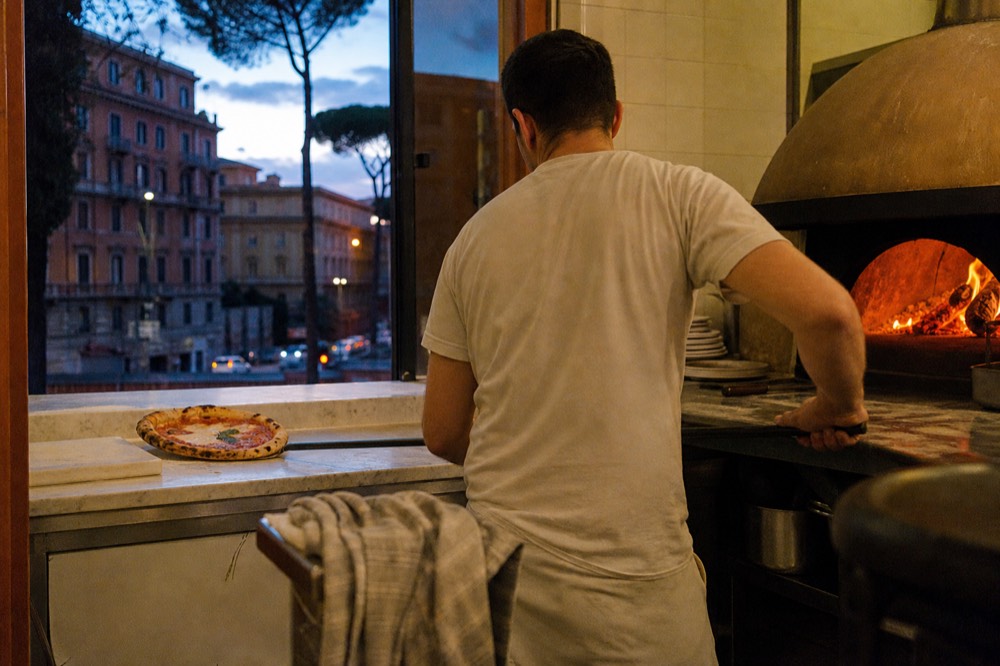
Pizza tonda is a thin, crisp round pie served whole at a table, in pizzerie that frequently open only in the evening and often take no bookings. Pizza al taglio is a rectangular slab displayed behind glass, cut with scissors to the size you point at, weighed, and priced by that weight. One is a dinner event, the other is a walk-up lunch.
The distinction is not stylistic trivia, it is the single most useful planning fact in Roman pizza. Tonda rooms like Ai Marmi in Trastevere and Da Remo in Testaccio are evening-only, walk-in, and queue at peak. Al taglio counters like Pizzarium and the city's forni are daytime businesses. A visitor who plans dinner at a bakery and lunch at a pizzeria has the clock exactly backwards.
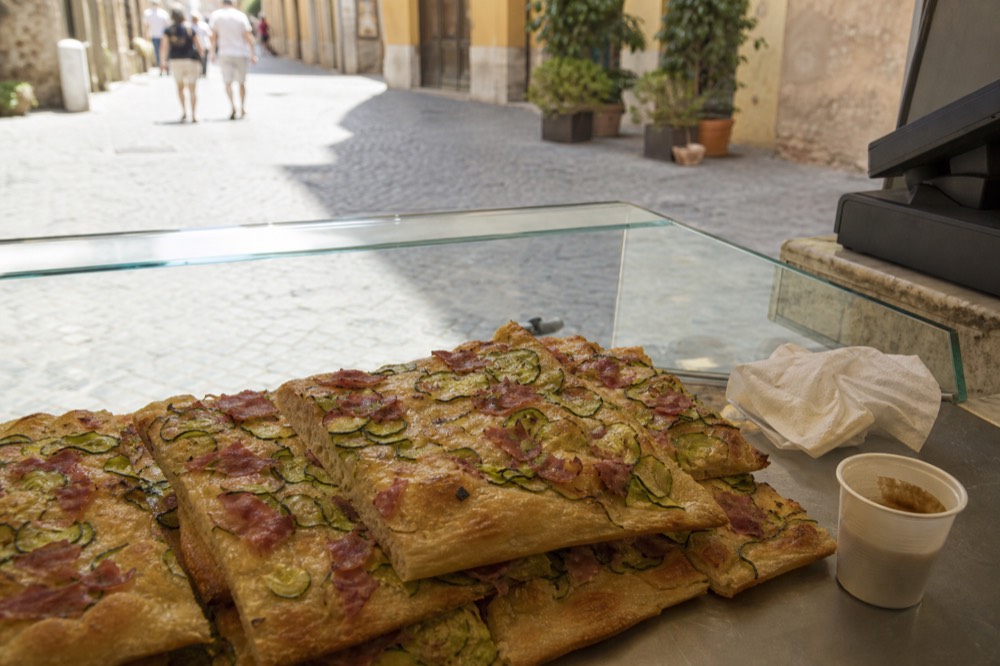
The formats also differ in what happens at the till. In a tonda pizzeria you order a whole pie from a menu and sit through the bake. At an al taglio counter you point at the tray, name the size, and the piece goes on the scale, so the price follows from the weight rather than from a printed per-slice figure. Different toppings carry different per-weight prices at the same counter, which is why two people can order what looks like the same amount of pizza and pay differently.
| Style | Format | When | How you pay | Typical friction |
|---|---|---|---|---|
| Pizza tonda | Whole round pie at a table | Evening in most classic rooms | Menu price per pie | Walk-in and queue, or phone ahead where the room books |
| Pizza al taglio | Rectangular slab, cut to order | Daytime, from mid-morning | By weight at the scale | Walk-in, counter queue only |
Neither style is a budget or luxury tier. Pizzarium's al taglio is the most decorated pizza in the city, and it is eaten standing on the pavement. The cheapest table of the evening is not the one with the best rankings. What the two styles share is that neither is built around the reservation book: Rome's pizza culture is a queue culture, and that is the honest starting point for planning.
Where To Eat Pizza Tonda In Rome
The classic tonda rooms are Ai Marmi in Trastevere, open since 1931 and evenings only, closed Wednesdays, and Da Remo in Testaccio, evenings only and closed Sundays. Emma near Campo de' Fiori takes telephone bookings but refuses requests made at the weekend or for the same day. Seu Pizza Illuminati and Avenida Calò carry the 2026 rankings.
Ai Marmi, also known as Panattoni, is the Trastevere institution of the style. No booking channel exists, the room serves in the evening, and Wednesday is its day off. The pies are the thin, cracker-crisp Roman rounds, and the wait for a table is the price of not planning. It scores 2 out of 5 (checked September 2026) on the friction scale, which in this city means: turn up and take your turn.
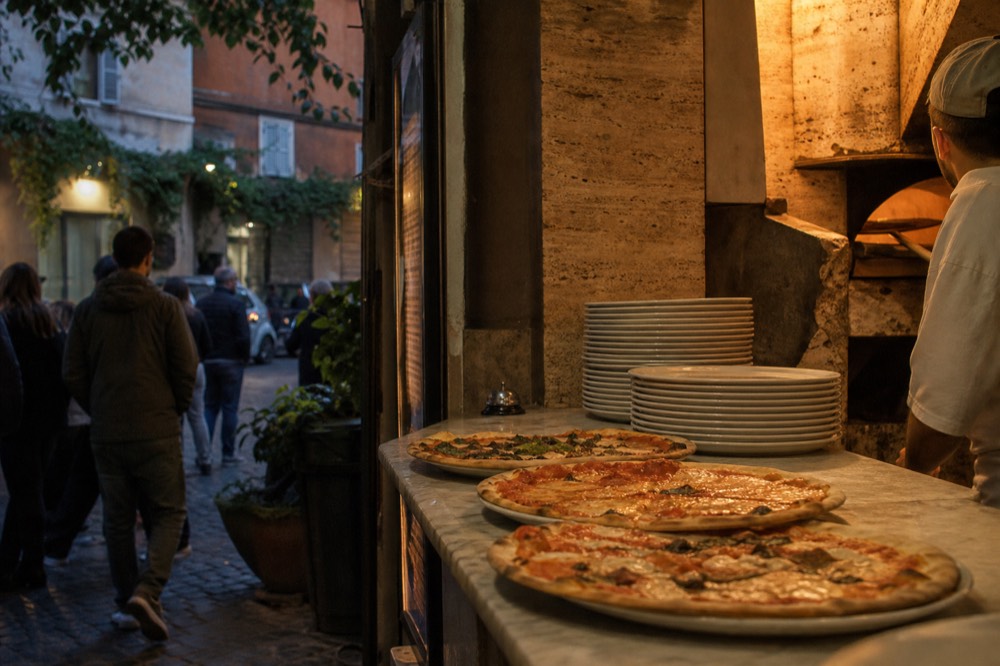
Da Remo in Testaccio is the same model in a different quarter: no reservations, evenings only, closed Sunday. Emma near Campo de' Fiori is the exception that proves the phone still matters. Its own site states that telephone bookings have priority, that email requests count only once the pizzeria confirms them, and that requests made at the weekend or for the same day will not be processed at all. Somebody deciding on Saturday where to eat on Saturday is already too late for Emma.
| Pizzeria | Quarter | Bookings | Closing day | Notes |
|---|---|---|---|---|
| Ai Marmi (Panattoni) | Trastevere | No | Wednesday | Evenings only, trading since 1931 |
| Da Remo | Testaccio | No | Sunday | Evenings only |
| Emma | Campo de' Fiori | Yes, by telephone | Not published in the record | Weekend and same-day requests refused |
| Seu Pizza Illuminati | Trastevere area | Check the live listing | Not published in the record | 2nd ex aequo, 50 Top Pizza Italia 2026 |
| Avenida Calò | Rome | Check the live listing | Not published in the record | 6th in 50 Top Pizza Italia 2026 |
The evening-only pattern has a second consequence people miss. Because tonda rooms open for dinner and run on queues, the timing of your whole day bends around them. Arrive at opening or accept the line. A street food walk through two quarters in the late afternoon is one way to bridge the gap between the lunch counters and the evening pizzerie, and the 2.5-hour two-quarter walk from Trastevere to Campo de' Fiori is the cheapest format on the roster for exactly that job.
The band above is the cooking-class family, which is the other way to eat Roman pizza: with your own hands in the dough. The rest of this page covers the counters, the rules and the rankings first, and returns to the classes further down.
Where To Eat Pizza Al Taglio In Rome
Pizzarium di Gabriele Bonci in Prati is the standard-bearer, with Tre Rotelle and 96 points in the Gambero Rosso 2026 guide, no seats, no bookings, and one dated report describing ninety people waiting. Panificio Bonci, Forno Campo de' Fiori, Antico Forno Roscioli and La Renella are the walk-in alternatives, several of them with no queue story attached at all.
Pizzarium is a standing counter, full stop. Its own contacts page states that no booking is needed and you order on the spot, and the product is cut and weighed one customer at a time. One dated diner report from March 2025 describes more than ninety people in the queue and two half-hour waits within a single visit, which is the clearest picture available of what peak hour looks like there. Sources disagree about which day Pizzarium closes, so no closing day is given here at all.
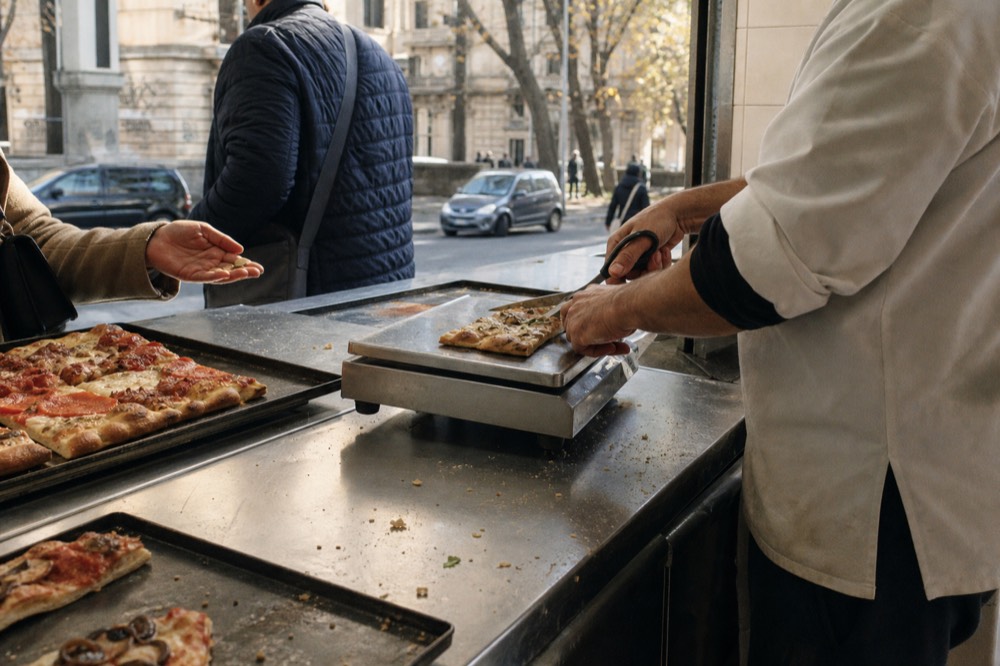
The alternatives are quieter. Panificio Bonci, the bakery half of the same operation, is closed Sunday and has no queue story in the record. Antico Forno Roscioli in via dei Chiavari is the bakery side of the Roscioli family business, the half you can simply walk into while the salumeria's restaurant upstairs runs on online bookings with a card guarantee. Forno Campo de' Fiori is likewise walk-in, though its line has no ticketing system: one dated account warns that you keep track of your own place or a regular will cut in front of you.
| Counter | Quarter | Bookings | Queue in the record | Closing day |
|---|---|---|---|---|
| Pizzarium Bonci | Prati | No | Dated report of more than ninety waiting | Sources disagree, none printed |
| Panificio Bonci | Prati | No | None in the record | Sunday |
| Antico Forno Roscioli | Campo de' Fiori | No | None in the record | Not published in the record |
| Forno Campo de' Fiori | Campo de' Fiori | No | A line with no ticketing system | Sunday |
| La Renella | Trastevere | No | None in the record | Not published in the record |
La Renella in Trastevere is the wood-oven bakery of the list, cash only, selling pizza al taglio and its own filone by weight. It scores 1 out of 5 (checked September 2026) on the friction scale, which is the definition of a place you walk into. That is the real spread of the al taglio world: the most decorated counter in the guide and a back-street forno are the same format, and only the queue differs.
If the queue side of Roman pizza appeals less than the eating side, a class solves it in two hours. The pizza class near Piazza Navona runs from $56.73 per person (checked September 2026), rated 4.9 across 1,506 reviews, and includes a pizza you make and eat, with coffee, tea or limoncello. Free cancellation is available on the live listing.
What Is The Pizza Rule In Italy?
The rules that actually affect a visitor are two. First, pizza al taglio is sold by weight, so you point at the size of the piece you want and the price follows from the scale. Second, sitting down to eat on Rome's monuments, fountains and their steps is prohibited under the city's public-order regulation, which means the slice is eaten standing, seated at a proper spot, or on the move.
The by-weight mechanic is the one that catches visitors out. There is no printed per-slice price to read before committing, because the piece is cut to the size you indicate and then weighed. Different toppings carry different per-weight prices at the same counter, so a smaller piece of a richer pizza can cost more than a larger piece of a plain one. The number is on the scale readout, not the menu board.
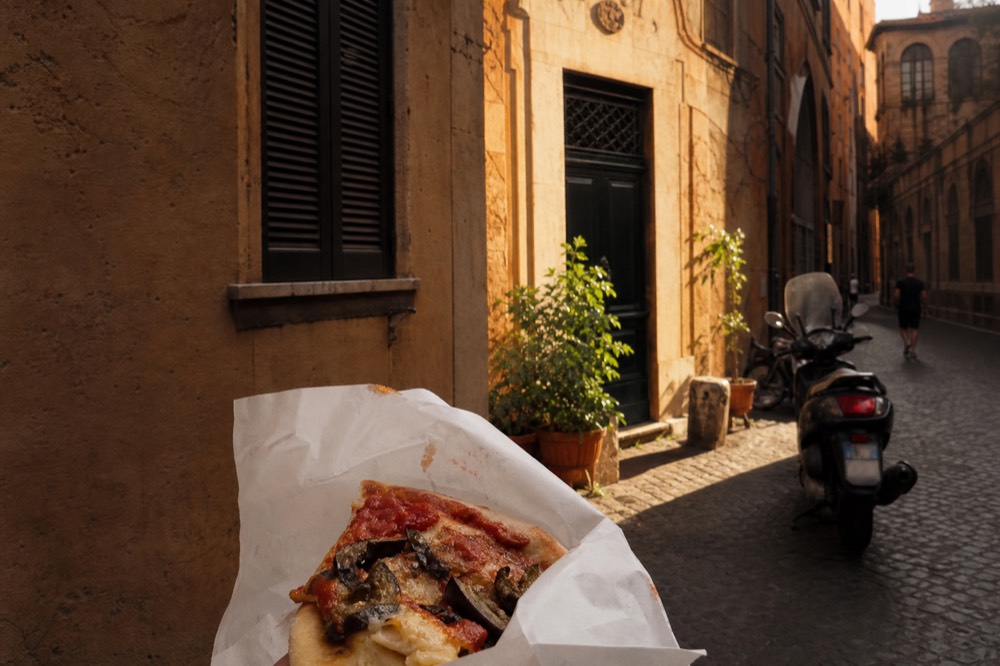
The street-eating rule is the other half. Rome's Regolamento di Polizia Urbana defines "bivacco" to include sitting, even while eating or drinking, on monuments, fountains and their steps, on archaeological remains, and on the street or in doorways where you block the way. Patrols enforce it. So the fountains and marble steps that look like the perfect perch for a slice are exactly the places the regulation rules out, and the fine is not printed here because the rule, not the amount, is what changes your behaviour.
| Situation | What the rule means | What you do instead |
|---|---|---|
| Ordering at an al taglio counter | Priced by weight, cut to order | Point at the size, watch the scale |
| Wanting to sit on fountain or monument steps | Prohibited as bivacco under the city regulation | Eat standing, or find a bench, step or seat away from heritage fabric |
| Evening at a classic pizzeria | Many rooms take no bookings | Arrive at opening or join the queue |
A third, softer convention rounds this out: the tonda pizzerie open for dinner and expect a seated, unhurried meal, while the counters trade through the middle of the day. Neither rule is written anywhere, but both are visible in how the best-known Roman tables and counters actually operate, and they explain why Romans treat pizza as two meals rather than one.
What Is The Difference Between Sicilian Pizza And Pizza Al Taglio?
Sicilian pizza, sfincione, is a thick, spongy, focaccia-like base typically carrying tomato, onion and anchovy, a Palermo street tradition. Roman pizza al taglio is a light, airy rectangular slab with a shorter, crisper crumb, cut to order and sold by weight. In Rome the practical contrast is with pizza tonda, but the Sicilian comparison is usually about the slice culture, and the two slice traditions are different products.
Both are street pizzas, which is why the question gets asked. But sfincione is dense and bready, closer to a laden focaccia, while Roman al taglio is engineered for height and lightness, often with a batter-like hydration that leaves a soft interior under a thin crust. The Roman version is also the more fluid format: toppings change through the day at a good counter, and the piece is sized to the customer, not pre-cut.
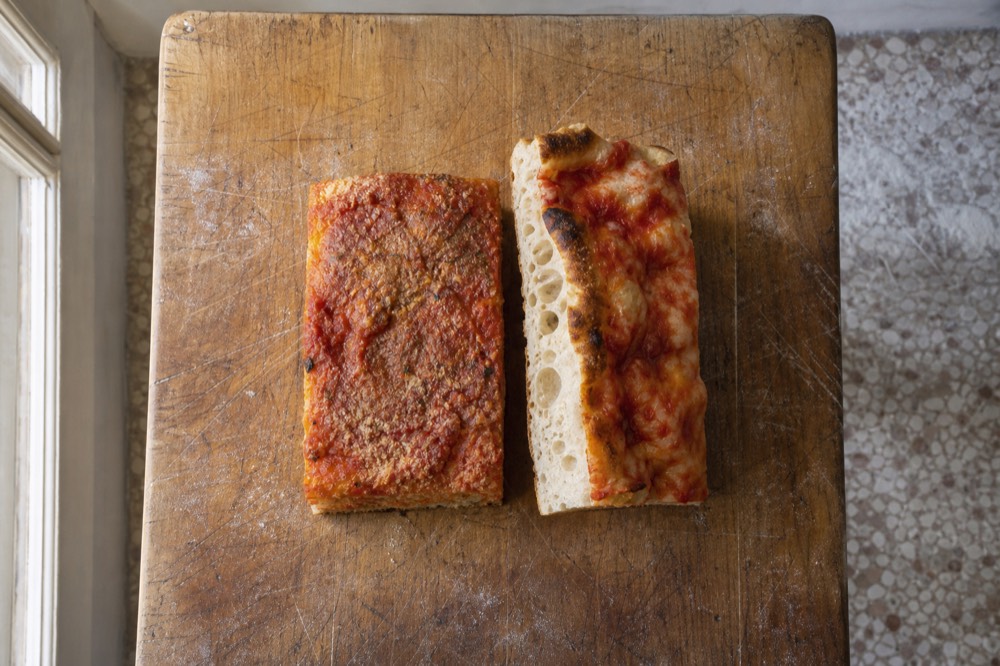
The eating mechanics differ too. Sfincione in its home tradition is a pre-cut square bought from a bakery or a street cart. Al taglio in Rome is cut with scissors or a blade only after you have said how big, and the scale settles the price. A visitor who has eaten the Sicilian version and expects a fixed price per piece will find the Roman system more flexible and less predictable, and a minority of Roman counters do sell fixed pre-cut slices at a flat per-piece price, which is worth noticing when you see it.
For a fuller treatment of Roman street food beyond pizza, including the fried counters that sit alongside the forni, the Rome street food guide covers supplì, pizza bianca and the bakery tradition in detail.
Cooking Your Own: Pizza Classes In Rome
The two-hour pizza class near Piazza Navona runs from $56.73 per person, is rated 4.9 across 1,506 reviews, and includes a pizza you make and eat, with coffee, tea or limoncello. The pizza or pasta class with gelato and wine runs from $56.62 (checked September 2026) and builds in unlimited wine. The pizza plus tiramisu or gelato class with flowing wine is the value floor of the family at from $41.33, rated 5 across 1,501 reviews.
One meeting-point detail matters before booking. The class that carries "Piazza Navona" in its listing title meets at Osteria Pasquino on Piazza di Pasquino, a different square from Piazza Navona itself. The fettuccine class is the one with a meeting point on Piazza Navona proper, at Restaurant Tucci, Piazza Navona 94, as the listing publishes. And the pizza plus tiramisu class publishes no meeting point, so nothing is stated here about where it starts.
The class family overlaps deliberately. The pizza or pasta choice class at from $56.62 (checked September 2026) lets each participant pick their format, with gelato or sorbet and unlimited wine on the roster, and the from $41.33 pizza plus tiramisu or gelato option runs three hours with flowing wine. All three carry free cancellation, which matters in a city where plans move with the weather and the queue.
A class also sidesteps the two frictions this page has already covered. There is no queue, because the seat is booked, and there is no by-weight pricing puzzle, because the ticket is fixed before you go. The Rome cooking classes guide covers the pasta side of the same ecosystem for travellers who want both meals in their own hands.
How The Roman Pizzeria Clock Works
Most classic tonda rooms open for the evening only, take no bookings, and queue at peak, while the al taglio counters trade through the middle of the day and wind down by late afternoon. The result is a city where pizza is available somewhere at almost any hour, but never the same style twice in the same window.
The records bear this out room by room. Ai Marmi: evenings only. Da Remo: evenings only. The forni and counters: daytime businesses. Emma takes phone bookings but its daytime line runs alongside an evening pizzeria service. There is no unified opening culture to memorise, only the pattern that each format has its own half of the day, and that the gap between the end of al taglio service and the start of tonda service is the awkward stretch.
| Format | Usual trading window | Bookings | Peak friction |
|---|---|---|---|
| Classic tonda pizzeria | Evening | Mostly no | The queue at opening |
| Al taglio counter | Daytime | No | The midday counter line |
| Forno / bakery | Daytime | No | Minimal at off-peak |
| Food hall counters | Long hours daily | No | Rarely any |
The walk-in culture has a compensating virtue: half of Rome's food roster has no booking mechanism to fail at. The gelaterie, coffee bars, bakeries, counters and food halls all simply open their doors. Mercato Centrale inside Termini runs long hours every day, and the Rome food markets guide covers where the covered markets fit into a pizza-day itinerary, including the Testaccio market's official Monday to Saturday trading window.
For the two-quarter evening walk, the street food tour through Trastevere and Campo de' Fiori runs from $48.37 per person (checked September 2026), rated 4.9 across 4,191 reviews, over about 2.5 hours in a small group. It meets at Fontana Piazza San Simeone and covers street-food tastings including pizza and supplì, which makes it a bridge between the daytime counters and the late-opening pizzerie.
An alternative with a different shape is the eat-like-a-local walk in the historic centre, rated 4.9 across 1,331 reviews (checked September 2026), covering five fried tastings including supplì, pizza, porchetta panini and fried artichoke over about 2.5 hours in a small group. It meets at Piazza di S. Simeone by the fountain, and its fried-food focus makes it the natural companion to a night that ends in a tonda pizzeria rather than replacing one. From $51.10 per person, per the live listing.
Gelato After The Pizza
The classic Roman pizza evening ends at a gelato counter, and the gelaterie are among the easiest businesses in the city: Giolitti near the Pantheon, Otaleg in Trastevere, Gelateria dei Gracchi in Prati and Fassi in Esquilino all take no bookings and score 1 out of 5 on friction. Otaleg in Trastevere serves until midnight on weekdays and until 01:00 on Friday and Saturday. (checked September 2026)
A late gelato window matters after a pizzeria queue. Otaleg's own published hours run to midnight Sunday to Thursday and to 01:00 on Friday and Saturday, which lines up with the tail of a tonda service. Giolitti, the counter trading since 1900, is the busiest gelato operation in the centre and still a counter you simply join (see Giolitti Verdict). Fassi, in its 1928 tiled hall in Esquilino, has room and no door policy at all.
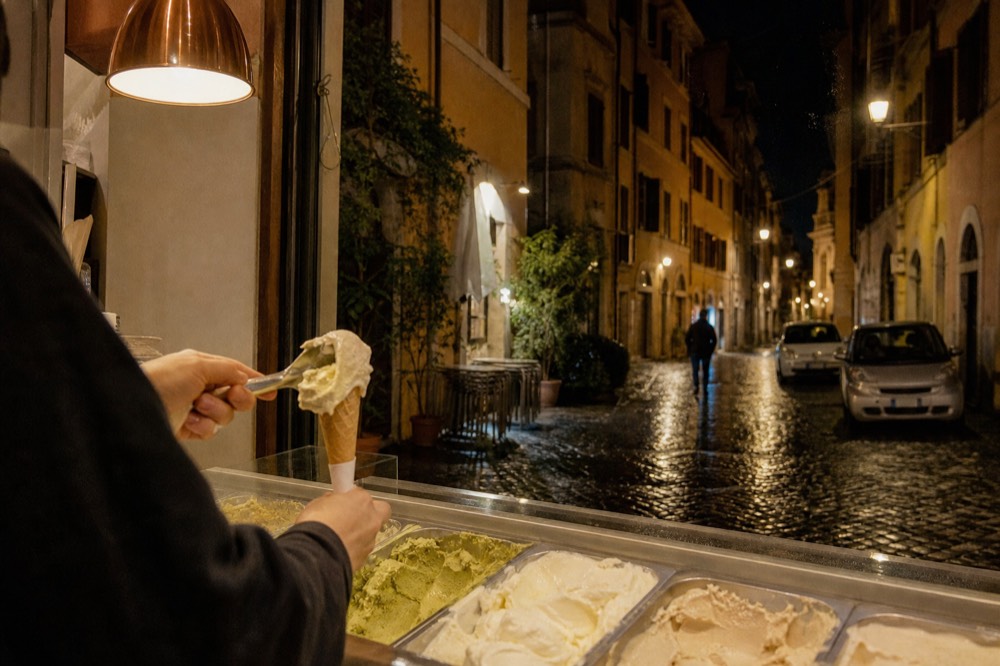
Reading the counter matters more in gelato than in pizza. Real artisanal gelato is stored flat in covered metal tins, with pistachio a dull khaki rather than a bright green, and banana greyish-white rather than yellow. Tubs heaped into tall fluorescent mounds are made for display rather than made that morning. The full story, including the city's gelato rankings and where each counter sits, is in the best gelato in Rome guide.
Reading The Rankings: What The Guides Actually Say
Rome's pizza rankings come from two independent lists: 50 Top Pizza Italia, which placed Seu Pizza Illuminati 2nd ex aequo and Avenida Calò 6th in 2026, and Gambero Rosso's Pizzerie d'Italia, which gave Pizzarium di Gabriele Bonci Tre Rotelle and 96 points in its 2026 edition. Neither list agrees with the other, because they measure different things.
The national list measures sit-down pizzerie and crowns a pizzaiolo of the year; the Gambero Rosso guide rates both styles and put an al taglio counter at the top of its own table. A traveller who wants one definitive answer will not find it, and does not need it: the honest reading is that Rome holds a top-two national tonda kitchen, a top-six one with a pizzaiolo award, and the highest-scored by-weight counter in the country. That is a deeper bench than almost any other city on either list, and it is the reason this page, and Best Restaurants in Rome as a whole, treats the two formats as separate decisions rather than one ranking.
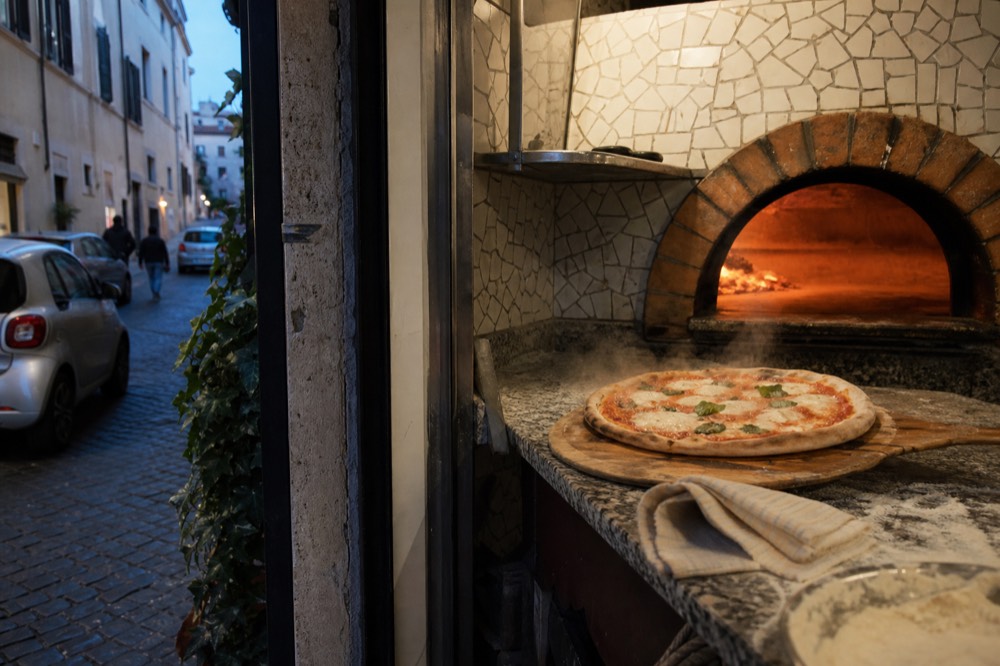
Rankings also change the queue, not the product. The dated report of ninety-plus people waiting at Pizzarium is what a 96-point score does to a counter with no booking system. The tonda rooms on the national list carry the same pressure in the evening. Going early, going on a weekday, or making the pizza yourself in a class are the three levers this site can honestly recommend, and all of them appear on this page because all of them are real.
Rome's best pizza is two answers, not one. Pizza tonda is the thin, crisp round pie of the evening pizzerie, with Seu Pizza Illuminati 2nd and Avenida Calò 6th in 50 Top Pizza Italia 2026. Pizza al taglio is the by-weight daytime slice, with Pizzarium holding Tre Rotelle and 96 points in the Gambero Rosso 2026 guide. The classic rooms take no bookings and the counters sell by the scale.
Common Questions About Pizza In Rome
What Is Considered The Best Pizza In Rome?
For pizza tonda, Seu Pizza Illuminati placed 2nd ex aequo and Avenida Calò 6th in 50 Top Pizza Italia 2026, with Francesco Calò named Pizzaiolo dell'Anno. For pizza al taglio, Pizzarium di Gabriele Bonci holds Tre Rotelle with 96 points in the Gambero Rosso Pizzerie d'Italia 2026 guide. The two lists measure different formats, so the best answer depends on whether you want a table or a counter.
What Is The Difference Between Sicilian Pizza And Pizza Al Taglio?
Sicilian pizza, sfincione, is a thick, spongy, focaccia-like base with tomato, onion and anchovy, a Palermo street tradition usually sold as pre-cut squares. Roman pizza al taglio is a light, airy rectangular slab cut to the size you request and sold by weight. Both are street formats, but the Roman version is sized and priced per customer at the scale rather than cut and priced in advance.
What Is The Pizza Rule In Italy?
The two rules that matter in Rome are these. Pizza al taglio is sold by weight, so you point at the piece you want and the price follows from the scale. And sitting down to eat on monuments, fountains and their steps is prohibited under the city's public-order regulation, so the slice is eaten standing or seated somewhere proper, not on heritage fabric.
Do Roman Pizzerias Take Reservations?
Mostly no. Ai Marmi and Da Remo are walk-in, evening-only rooms with no booking channel. Emma takes telephone bookings but refuses requests made at the weekend or for the same day. The al taglio counters take no bookings anywhere, because they are counters, not dining rooms.
Why Is Pizza Al Taglio Priced Differently For Two People Ordering The Same Thing?
Because it is sold by weight. Each piece is cut to the size you indicate, weighed, and priced on that weight, and different toppings carry different per-weight prices at the same counter. Two pieces that look similar can differ in topping density and cut size, and the scale settles the difference.