What Is The Difference Between Supplì And Arancini?
Supplì and arancini are both fried rice balls, but they belong to two different cities, two different shapes and two different fillings. Here is how to tell them apart in Rome.
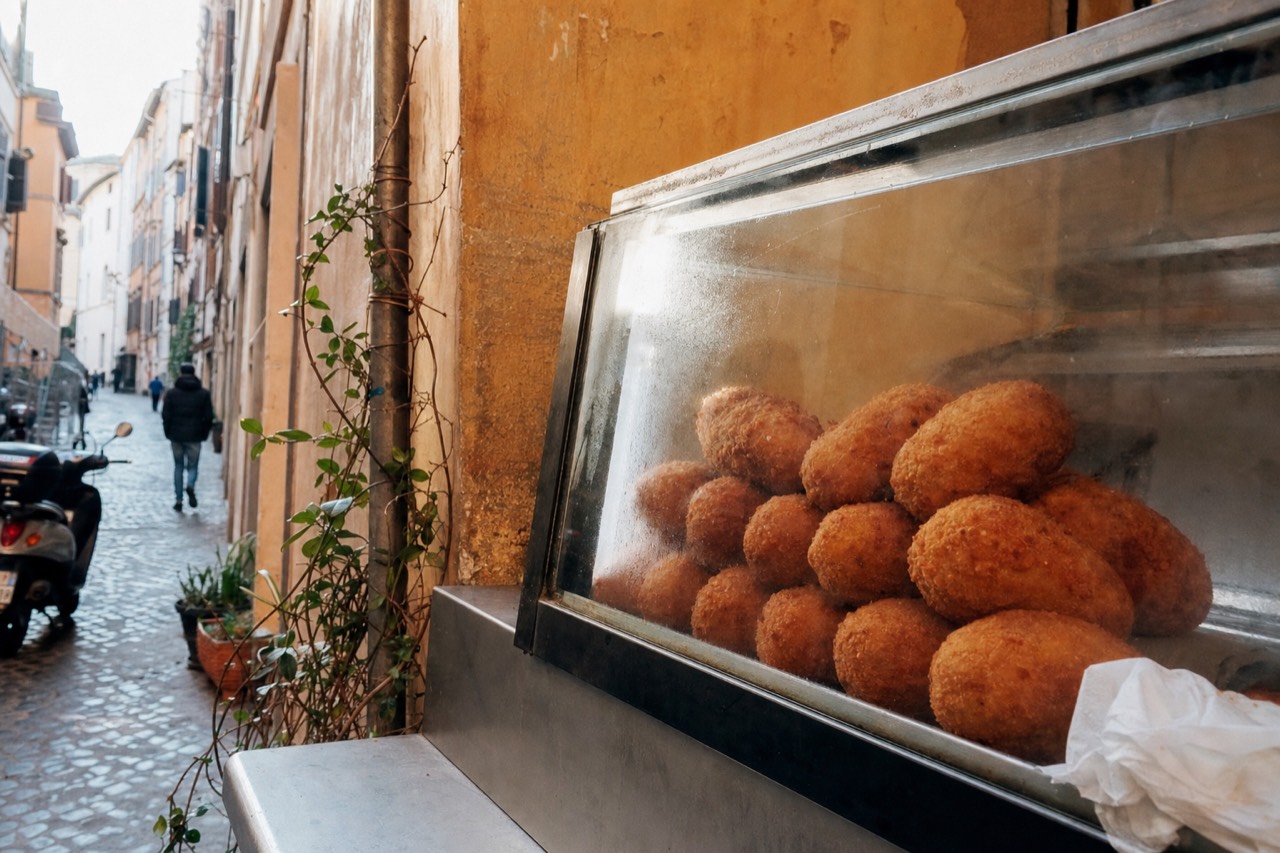
Two fried rice balls sit in the same display case at a Roman takeaway counter, and most visitors order them by pointing, because the differences between them are not written anywhere on the glass. The supplì is this city's own: an oval croquette of rice bound with ragù, hiding a molten mozzarella heart, sold at bakeries, friggitorie and market stalls that take no booking of any kind. The arancino arrived from Sicily with a different body plan, a saffron-tinted risotto shell and a habit of turning up filled with anything from meat sauce to spinach and cheese.
The difference is fourfold: the supplì is Roman and oval with a ragù-and-mozzarella filling, while the arancino is Sicilian, round or conical, usually built on saffron risotto, and filled with anything from ragù to butter and ham or aubergine. The supplì is also the one named for a telephone, because its mozzarella stretches into a long thread when you break it open. In Rome, the supplì is everywhere and the arancino is the visitor.
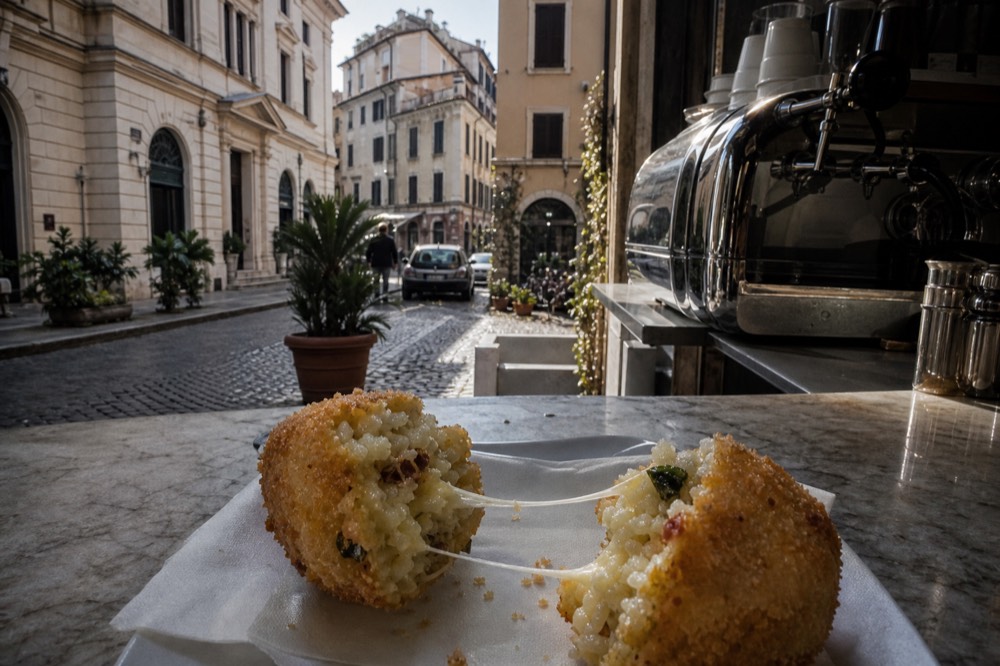
The name is the part everyone remembers. Romans say supplì al telefono for the classic version, and the reason is visual: bite through the crisp crust and the melted mozzarella runs between the two halves in a string that looks like the coiled cord of an old telephone handset. The arancino has no equivalent nickname, because its fillings tend to be spooned into a pocket of rice rather than strung through it. One is a cheese pull, the other is a stuffed sphere.
Both are bar food in the truest sense. You buy them standing, at a counter, often within arm's reach of the espresso machine, and you eat them within minutes of leaving the fryer. That is the whole serving style, and it explains why neither one has ever needed a reservation system, a queue manager or even a table. The quality gap between a good one and a bad one is almost entirely a gap of freshness: a fried rice ball sitting under a heat lamp is a different food from one that comes out of the oil as you pay.
If you want to taste the difference rather than read about it, a guided walk is the most efficient way to cover several counters in one evening, since no single venue in Rome sells both at their best:
Where Do Supplì And Arancini Come From?
The supplì belongs to Rome and its friggitorie, the small takeaway fryers of the historic centre and Trastevere, and the standard filling is rice cooked in tomato ragù around a stick of mozzarella. The arancino is Sicilian, most strongly Palermo and Catania, with roots in Arab-era saffron rice, and it is typically a meal-sized sphere or cone rather than a snack. Rome borrowed the arancino late; it did not invent it.
The two foods have opposite relationships with the cities that eat them. In Sicily, the arancino is lunch: substantial enough that many bars there sell nothing else at midday, and regional enough that Palermo and Catania disagree even about the word, with Palermo saying arancina and Catania saying arancino. In Rome, the supplì is a between-meal bite, the thing you eat standing outside a bakery while you decide where dinner is. The size difference follows from that: an arancino can weigh like a small loaf, while a supplì is meant to be finished in three or four bites.
The word supplì itself is a Roman contraction of the French surprise, for the mozzarella hidden inside the rice. The Sicilian name is older and plainer: arancina means little orange, which is exactly what the round, golden-crusted version looks like. Two names, two metaphors. One food hides something, the other one resembles a piece of fruit, and both metaphors are honest about what you get.
Here is the comparison in one place:
| Feature | Supplì (Rome) | Arancino (Sicily) |
|---|---|---|
| Shape | Oval, elongated | Round, or a cone in eastern Sicily |
| Rice base | Plain or tomato-tinted rice | Saffron risotto |
| Classic filling | Ragù with a mozzarella centre | Ragù, or butter and ham, or spinach with cheese |
| Name origin | From the French "surprise" | "Little orange" |
| Size | Snack, a few bites | Often meal-sized |
| The cheese pull | Yes, the mozzarella strings, hence "al telefono" | Not usually the point |
| Where you buy it | Roman bakeries, friggitorie, market stalls | Sicilian bars and takeaway fryers |
For travellers, the practical upshot is simple: in Rome, order the supplì, and treat any arancino on a Roman menu as a Sicilian import that may or may not be done well. In Sicily, the reverse holds. The two foods are cousins, but each is best in its own city, and the supplì has the stronger claim on your time in Rome because it is the one fried to order in front of you.
What Is Supplì Al Telefono?
Supplì al telefono is the classic Roman version: rice cooked in a slow tomato and meat ragù, shaped around a piece of mozzarella, breaded and deep-fried so the cheese fully melts. Broken in half, the mozzarella runs between the two halves in a long thread, and that string is the "telephone" of the name. The thread only happens when the supplì is fresh out of the fryer.
The ragù matters as much as the cheese. The rice for a proper supplì is not boiled separately and then flavoured; it is cooked in the ragù itself, absorbing the tomato and the meat as it softens, so the whole croquette tastes of the sauce rather than of neutral rice with a filling. That is also the difference between a supplì and a lazy one: a filling of plain rice with a cube of cheese dropped in the middle is a rice ball, not a supplì, and Romans can tell before the first bite because the colour is wrong. Proper ragù rice carries a warm orange-pink tint all the way through.
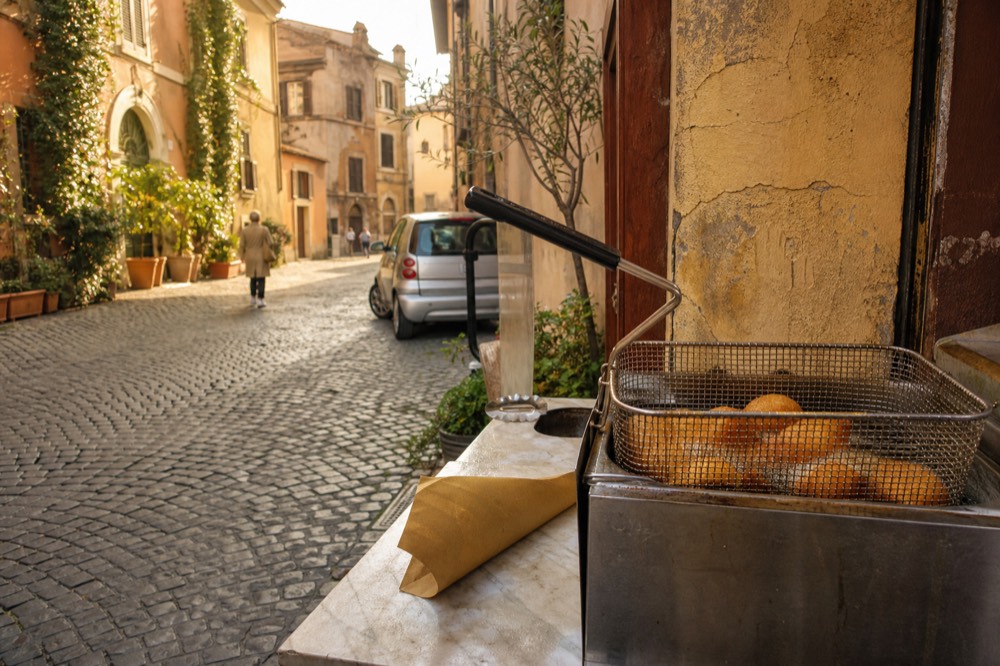
The mozzarella pull is the test of freshness. A mozzarella thread needs the cheese to still be molten, which means the croquette left the oil within the last few minutes. Under a heat lamp, the cheese re-sets into a dense plug, the crust softens, and the whole thing becomes a heavier, sadder object. The best Roman counters therefore fry in small batches through the afternoon and evening rather than cooking a mountain once and selling it down. If the case in front of you holds a pyramid of identical cold supplì, that is the heat-lamp version. If the fryer is running, wait the two or three minutes.
The cousin dishes are worth knowing, because Roman fryers rarely sell supplì alone. Rice crochette are plain rice and cheese croquettes without the ragù, lighter and cheaper to make. Fiore di zucca fritto, fried courgette blossom with a mozzarella heart, is the same idea in a different wrapper and appears in the same display cases. And the panzerotto, a small folded and fried pocket of pizza dough with tomato and mozzarella, is a Puglian import that has settled comfortably into Roman takeaway cases. The counters that do one of these well usually do all of them, because the discipline is the same: fry small, fry often, sell fast.
Where To Eat Supplì In Rome Without A Reservation?
Supplì are sold at walk-in counters only: friggitorie, bakeries and market stalls, none of which take bookings, so the entire category is friction-free by design. The known names include Supplì Roma in Trastevere, the CasaManco pizza stall at banco 22 of the Nuovo Mercato Testaccio, and the fried counters of the street-food walks in the historic centre. The only constraint is opening hours, not reservations.
Start with the dedicated fryers. Supplì Roma is a friggitoria in Trastevere that has built its name on the classic ragù-and-mozzarella version, sold from a counter with no seats and no booking channel at all; it is closed on Sundays and public holidays, and it is one of the small number of cash-only counters in this city, so carry notes. The walk-in reality is the point of the format: a friggitoria has a fryer, a display case and a till, and none of those three things can be reserved.
Then the markets. The Nuovo Mercato Testaccio is open Monday to Saturday from 07:00 to 15:30, closed Sunday, and inside it CasaManco holds banco 22, a pizza alla pala stall that also fries its own supplì, which the market's own page singles out. A few aisles away, Mordi e Vai fills bread rolls with boiled-meat sandwiches at lunchtime, with a queue the market itself describes as often worth the wait. The whole building is a morning-and-lunch place: it shuts at half past three, so a visitor arriving for dinner finds the doors closed and nothing frying anywhere inside.
| Counter | Neighbourhood | What it fries | Booking |
|---|---|---|---|
| Supplì Roma | Trastevere | Classic supplì al telefono | Walk-in only, closed Sundays |
| CasaManco, banco 22 | Testaccio market | Supplì plus pizza alla pala | Walk-in, market hours only |
| Trapizzino Testaccio | Testaccio | Pizza bianca pockets, plus fried snacks | Walk-in with table service, open daily noon to 23:00 |
| Bakery counters, e.g. Forno Campo de' Fiori | Centro Storico | Pizza bianca and fried snacks | Walk-in only, hold your place in line |
Trapizzino in Testaccio deserves a line of its own, because the trapizzino is the most recent Roman invention to join the old fried canon: a triangular pocket of pizza bianca, the same bread that wraps a good supplì case, stuffed with slow Roman stews. It was created by Stefano Callegari and now trades across six Rome locations, and the Testaccio branch is open every day from noon to eleven at night with service in the room, which makes it one of the few street-food formats on this list that also works for dinner.
The larger answer is that the supplì belongs to a whole walk-in half of Rome that no reservation system touches. A deeper rundown of that world is in the guide to Rome's street food, and the what is a trapizzino piece covers its nearest cousin in detail. Gelaterie, coffee bars and bread bakeries operate the same way: you arrive, you queue for a minute, you are served. This is the half of the Roman food scene where nothing is hard, and it is worth saying plainly that the hardest tables in this city sit alongside dozens of counters that ask nothing of you but arrival.
A guided walk stitches those counters together efficiently. The Five Fried Tastings, Historic Centre outing covers five tastings including supplì, pizza, porchetta panini and fried artichoke in a 2.5-hour small-group format, rated 4.9 across 1,331 reviews, with free cancellation available, a from-price of $51.10 per person, and a meeting point the listing publishes at the fountain in Piazza di S. Simeone:
Are Arancini Easy To Find In Rome?
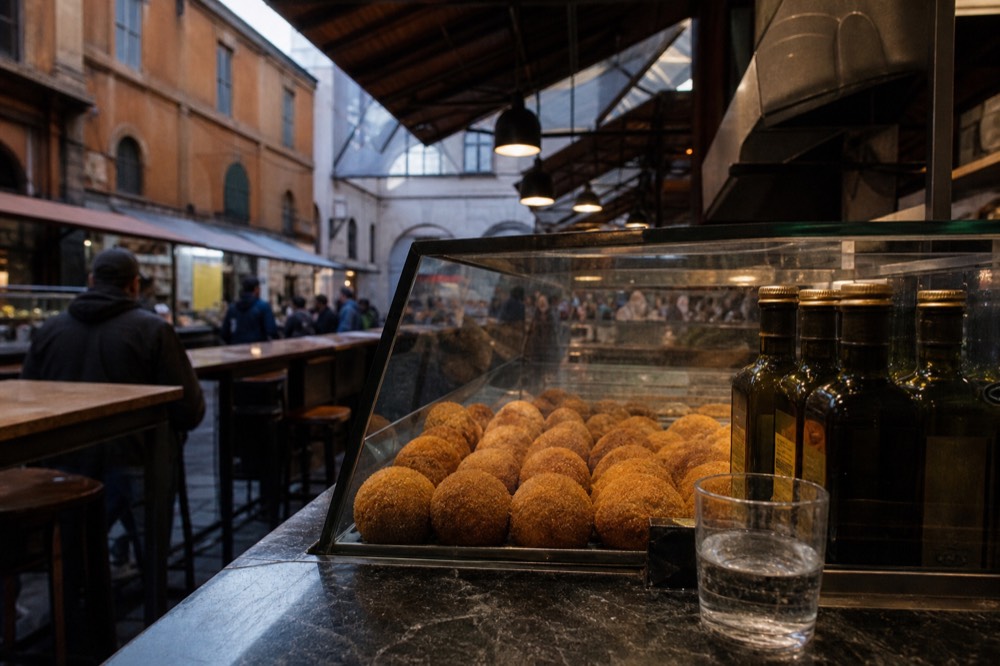
Arancini in Rome are an import, so they appear where Sicilian food has landed: a handful of Sicilian-run takeaway counters, the food-hall floors of Mercato Centrale near Termini, and the occasional deli case. They are not native to Roman friggitorie, and a generic Roman bakery selling an "arancino" alongside its supplì is usually selling the same rice ball in a different shape.
The honest comparison in Rome is between a local food at its peak and a visitor food at its average. The supplì you buy in Trastevere or Testaccio is being made in the city by people who make nothing else; the arancino you buy in the centre is more often a manufactured or mass-fried item sitting in a mixed case. That is not a rule, and there are Sicilian-run exceptions worth seeking out, but the base rate is real, and it is the same base rate that governs any regional dish eaten far from its home region.
Mercato Centrale is the main reliable answer for a visitor. It is a food hall inside the Termini station building, open every day from 07:30 to 23:30, built from artisan counters on three levels, and it takes no reservations at any of them. Between the fresh pasta, pizza and trapizzino counters there is Sicilian frying, and the long daily hours mean an arancino there is at least being turned over all day rather than sitting from lunchtime. For a traveller whose hotel is near the station, it is the one place where both the Roman and Sicilian versions of fried rice are sold a short walk apart.
The other place arancini show up is the guided food walk. Several of Rome's street-food tours route through the historic centre and the Jewish Ghetto, and the fried-food stops on those routes often include both supplì and a Sicilian arancino, which makes them one of the few contexts where you can taste the two side by side in the same hour and settle the difference for yourself. The 2.5-Hour Two-Quarter Walk, from $48.37 per person (checked September 2026), rated 4.9 across 4,191 reviews, covers street-food tastings including pizza, supplì and gelato across Trastevere and Campo de' Fiori in a small group with free cancellation.
Beyond that, the advice is to lower your expectations of the arancino in Rome and raise them for the supplì. If Sicily is on the same trip, save the arancino for Palermo or Catania, where it is lunch rather than a souvenir. If Rome is the whole trip, eat the Roman version, because the Roman version is the one this city has spent a century refining, and the fryers who do it best are the ones you can simply walk into.
How Can You Tell A Fresh Supplì From A Tired One?
Look at the fryer, not the case. A fresh supplì is made in small batches, comes out at a deep even gold, is hot in the hand within a minute of paying, and breaks open with a running cheese thread. A tired one is pale or dark-spotted, uniform in its pile, room-temperature, and splits into a dry plug of re-set mozzarella. The counter that fries to order is always worth a short wait.
The colour tells you the oil. A croquette fried in fresh oil at the right temperature comes out an even deep gold and stays crisp for the walk to the nearest bench. Oil that is old or too cool gives a pale, greasy shell that softens within minutes; oil that is too hot browns the outside before the rice inside has warmed, giving a dark shell around a cold middle. Dark spots and streaky colouring on a case full of identical croquettes are the sign of a batch that was fried hours ago and has been absorbing oil ever since.
The shape tells you the hand. A supplì moulded by hand is slightly irregular, a touch wider in the middle, never identical to its neighbours. Machine-formed ones come out with the same clinical symmetry as everything else from the same supplier, and a case of perfectly uniform croquettes usually means they arrived frozen rather than being made in the back of the shop you are standing in. Rome has both kinds of counter, and there is nothing wrong with a good frozen product fried properly, but the ragù rice and the real mozzarella heart are far more common in the handmade ones.
The timing tells you everything else. The cheese pull that gives the supplì its name only exists for a few minutes after frying, so the counter to pick is the one whose fryer is actually running. Roman friggitorie that care tend to fry through the pre-dinner and pre-lunch rushes rather than once at noon, and the staff will tell you the wait if you ask, because a two-minute wait for a fresh one is normal and they know you will say yes (see Roman Dinner Times). This is also why the suppliced counters of the market close mid-afternoon: the whole supply of fresh frying in Testaccio ends when the market's shutters come down at half past three.
Should You Walk A Supplì Route Or Join A Food Tour?
A self-guided supplì route costs you nothing but the walk between Trastevere, Testaccio and the historic centre, and every stop on it takes no booking. A guided street-food walk from $48.37 per person (checked September 2026) covers the same counters in one outing, with a guide who handles the ordering and the route, and free cancellation on every tour on the roster. The choice is pace, not access.
Doing it yourself is genuinely viable, which is not true of everything in this city. A walk-in day can start at a bakery counter in the historic centre in the late morning, cross the river into Trastevere for the dedicated friggitorie around lunch, and still reach Testaccio before the market closes at 15:30, with gelato and espresso filling the gaps (see Best Gelato In Rome). Nothing on that route requires a phone call, a card guarantee or a booking window. The only real obstacles are the Sunday closures at several of the counters and the Testaccio market's mid-afternoon shutdown, both of which are calendar problems rather than access problems.
The case for the guided version is coverage and speed. The best of the fried counters are scattered across two quarters and a market district, a visitor has no way of knowing which case is frying to order and which is reheating, and the ordering at a Roman friggitoria is fast, verbal and in Italian. A small-group walk solves that in one booking: the routes already run through the counters where the frying is fresh, the guide orders, and the price is fixed per person before you set out. On the roster, the cheapest of these runs from $48.37 (checked September 2026), and the fullest fried-itinerary options climb from there.
| Format | Price from | Duration | Group | What you eat |
|---|---|---|---|---|
| Five Fried Tastings, Historic Centre | From $51.10 per person | 2.5 hours | Small group | Supplì, pizza, porchetta panini, fried artichoke |
| 2.5-Hour Two-Quarter Walk | $48.37 per person (checked September 2026) | 2.5 hours | Small group | Street-food tastings including pizza, supplì, gelato |
| Local Guide, Wine and Beer | $55.55 per person | 2.5 hours | Small group | Food tastings with a sip of wine and beer |
Every one of those tours carries free cancellation, and none of them enters a restaurant that needs a reservation, which is the quiet advantage of the whole format: the guided fried-food walk is the one booked experience in Rome whose subject matter is entirely made of places you could otherwise walk into yourself. You are paying for route, pace and translation, not for access. Some visitors prefer to spend that budget on one long dinner at a trattoria that does need booking, and both choices are reasonable.
The Local Guide, Wine and Beer walk is the middle option, from $55.55 per person (checked September 2026), rated 4.8 across 150 reviews, meeting at the Basilica di San Bartolomeo all'Isola on the Tiber island with food tastings and a drink included, and the same free-cancellation terms:
Between the two, the self-guided day rewards the traveller who likes to move slowly and improvise, and the tour rewards the one with a single free evening and a fixed appetite. Whichever you choose, end on a fresh one: the whole point of the supplì is that it was fried minutes ago, and that mozzarella thread only happens once.
Whether you plan a route yourself or book a walk, the wider picture is on Best Restaurants in Rome, where the reservation-heavy tables and the walk-in counters are laid out side by side, so you can see exactly which parts of this city's food need planning and which parts need only hunger.
The core answer holds across every version of the question: the supplì is Rome's own fried rice ball, oval, ragù-flavoured and mozzarella-hearted, while the arancino is Sicily's, bigger, saffron-gold and more variously filled. The supplì is the one named for a telephone, and the one you eat in Rome. Everything below unpacks the details, from the cheese pull to where each is fried.
Common Questions About Rome's Fried Rice Balls
What Is The Difference Between Supplì And Arancini?
A supplì is Roman, oval, made with rice cooked in tomato ragù and a mozzarella centre that strings when broken. An arancino is Sicilian, round or cone-shaped, usually built on saffron risotto, with a wider range of fillings, and it is typically a bigger, meal-sized object.
What Does Supplì Al Telefono Mean?
It means "telephone supplì": when you break the fried croquette in half while it is fresh, the melted mozzarella stretches in a long thread between the two halves, resembling an old coiled telephone cord. The pull only appears when the supplì has just left the fryer.
Are Arancini From Rome?
No. Arancini are Sicilian, associated above all with Palermo and Catania. Rome's own fried rice ball is the supplì, and arancini in Rome are an import, found mainly at Sicilian-run counters and food halls such as Mercato Centrale near Termini.
Do I Need A Reservation To Eat Supplì In Rome?
No. Supplì are sold at walk-in counters, bakeries, friggitorie and market stalls, none of which take bookings. The only constraints are opening hours: several counters close on Sundays, and the Testaccio market, home to the CasaManco stall at banco 22, shuts at half past three in the afternoon.
Is A Supplì The Same As A Rice Croquette?
Not quite. A plain rice-and-cheese croquette is the same technique without the ragù, and Roman fryers sell both. The supplì proper has its rice cooked in meat and tomato ragù, giving the whole croquette a warm colour and flavour, plus the molten mozzarella heart.
Where Should I Try A Fresh Supplì In Rome?
Counters that fry in small batches through the day: Supplì Roma in Trastevere, the CasaManco stall inside the Testaccio market, and the bakery and friggitoria counters of the historic centre. Look for a fryer that is running rather than a tall pile sitting under a lamp.